

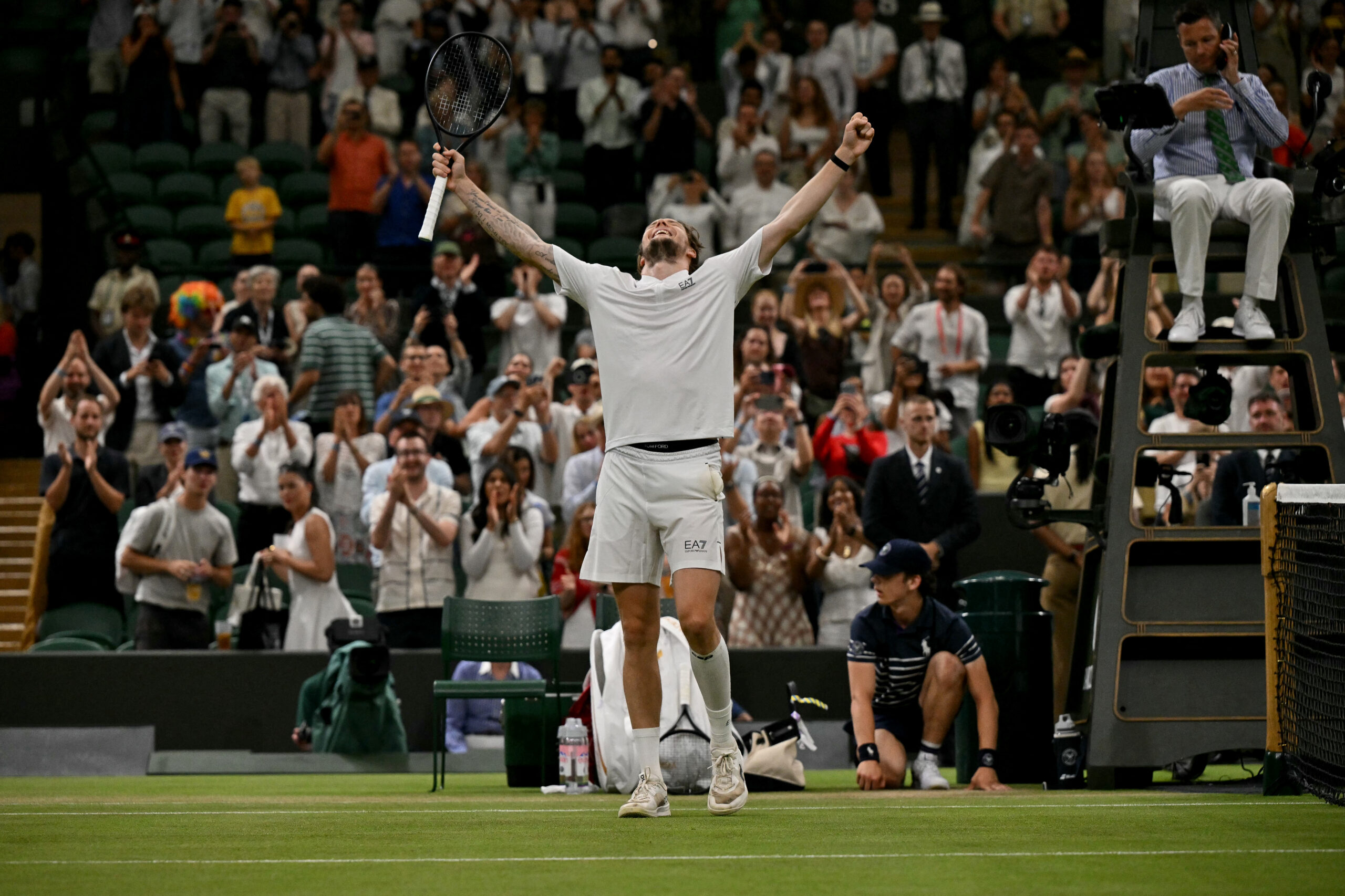
Alexander Bublik reached the fourth round of Wimbledon for the second time on Saturday, outlasting Frances Tiafoe 4-6, 7-6(5), 7-6(11), 4-6, 6-3 in a match that ran four hours and 10 minutes and turned, as so many of his matches do, on his serve. He struck 48 aces against six double faults. Break points were scarce for both men; Bublik converted just one of his 10, and the contest was decided in the tiebreaks.
The reset. Bublik, 29, has described a mid-2025 slump — and a short, unplanned break in Las Vegas — as the turning point of his career. What followed was the most productive run he has had: titles at Halle, Gstaad, Kitzbühel and Hangzhou, a maiden Grand Slam quarterfinal at Roland Garros, and an alternate’s place at the ATP Finals. He opened 2026 by winning Hong Kong and climbing to a career-high World No. 10 on Jan. 12, becoming the first man representing Kazakhstan to reach the top 10.
Built for the surface. The reinvention has been most visible on grass. Bublik is a two-time Halle champion, and the components of his game — a first serve among the biggest on tour, a slice he can flatten or float, and a willingness to shorten points that few opponents match — reward the low bounce and quick court at the All England Club. Against Tiafoe, that package produced a third set in which the American held nine set points, five of them at 6-5 and four more in the tiebreak, and converted none. Bublik edged the breaker 13-11 and controlled the decider.
“This match will remain in my heart forever,” Bublik said afterward.
What’s next. The win sets up a last-16 meeting with sixth-seeded American Taylor Fritz, who reached finals at Stuttgart and Halle during the grass swing and beat Lorenzo Sonego in four sets on Saturday. It is a matchup of two of the largest serves left in the draw, and for Bublik it carries a specific stake: he has never reached a Wimbledon quarterfinal, and a win would give him the second major quarterfinal of his career.
The larger read. The question that has trailed Bublik since last summer is whether the 2025 surge was a spike or a new floor. His Slam results since point to the latter — a fourth round at the US Open, a fourth round at the Australian Open, and now a second week at Wimbledon — even as the showmanship that made his name remains intact. Asked to explain the shift in his approach, he declined to, telling reporters they should answer the question for themselves.