

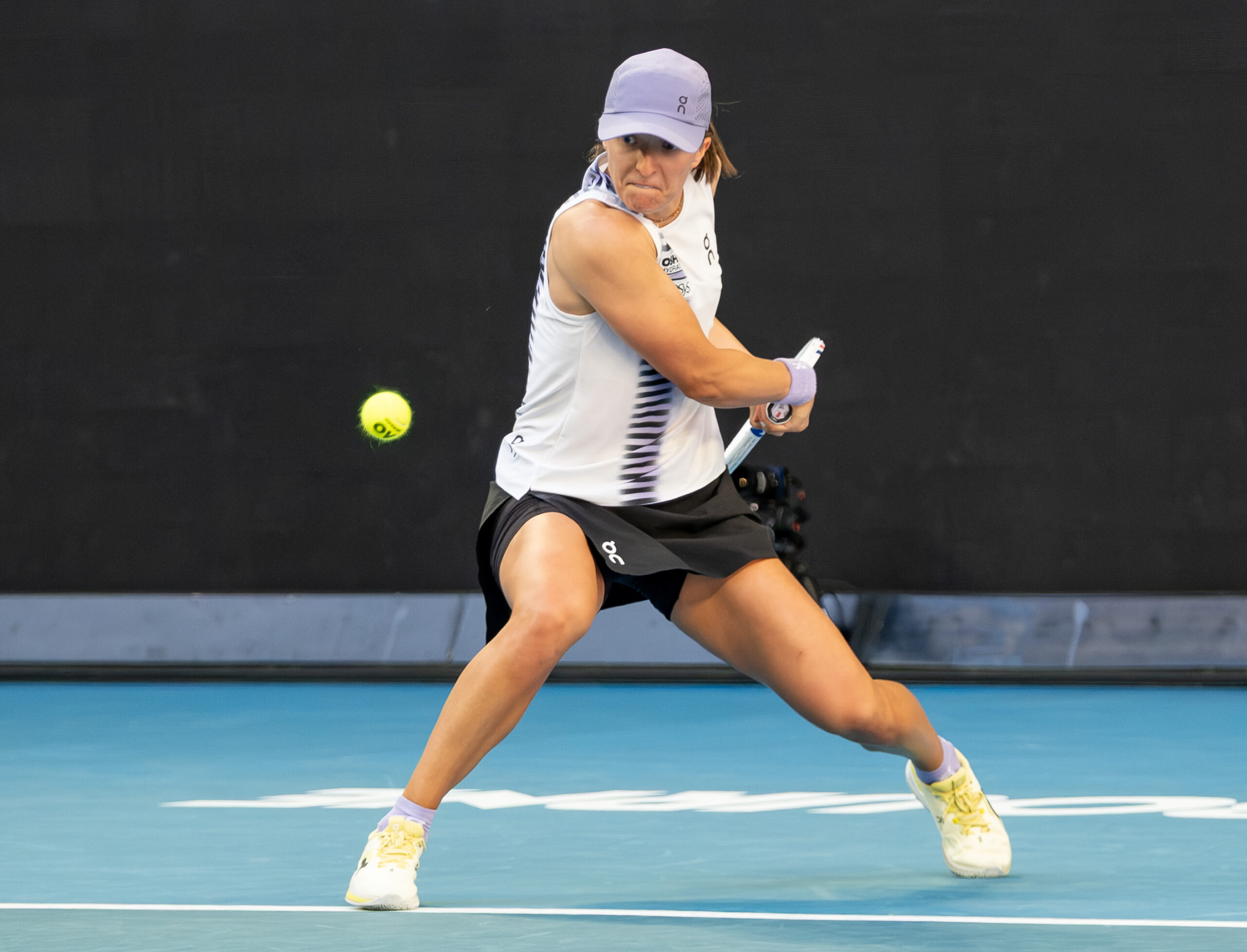
Iga Świątek has become the subject the sport cannot stop discussing. In the quiet week after Wimbledon, with the tour scattered across low-key clay and hard-court events, the game’s leading analysts have instead turned their attention to the six-time Grand Slam champion and the steep decline in her form.
Brad Gilbert, the American coach who guided Andre Agassi, Andy Roddick and, more recently, Coco Gauff, was blunt. Of all the top players who have wobbled this season, he said, it was the Pole whose fall had struck him hardest. Speaking on the Big T Podcast, as reported by ProFootballNetwork, Gilbert said Świątek had surprised him the most in terms of “how much she’s fallen off,” noting that she changed coaches earlier in the year and has not reached a final in roughly ten months.
The numbers bear the diagnosis out. Świątek arrived at Wimbledon ranked No. 3; her failure to defend the title she won a year ago — she was beaten in the third round by Alexandra Eala — dropped her to No. 8, ending a run of more than five consecutive years inside the top three. She now sits around No. 12 in the Live Race to the WTA Finals, raising the once-unthinkable prospect that the four-time Roland Garros champion could miss the season-ending championships altogether.
The drought is the starkest measure of all. Świątek has not lifted a trophy, or even reached a final, since winning the Korea Open in the autumn of 2025 — a barren stretch for a player who spent much of the previous four seasons as the dominant force in women’s tennis. This year’s Grand Slam record tells the same story: a fourth-round exit at Roland Garros followed by the early Wimbledon defeat.
Kim Clijsters, the four-time major champion and former world No. 1, offered a more diagnostic reading. Speaking on the Love All Podcast, she suggested the problem is not technical but psychological, rooted in the weight of expectation the Pole places on herself. It almost feels, Clijsters said, as though Świątek “wants it too much” — an obsession she believes is visible in the player’s body language between points and on the walk back to her chair. Much of that pressure, the Belgian added, is self-imposed, the by-product of years spent setting a standard she is now straining to reach.
The context behind the slump includes a significant off-court change. Świątek parted with coach Wim Fissette after the Miami Open earlier this year and, following a period of speculation, appointed the Spaniard Francisco Roig, a long-time member of Rafael Nadal’s team. The partnership delivered a Wimbledon fourth round and little sign yet of the turnaround both sides are chasing.
Now the hard-court swing brings a particularly awkward examination. Świątek is the reigning Cincinnati Open champion, having won the title in 2025, which means she arrives at the last big US Open tune-up in August defending a substantial haul of ranking points during the worst run of her career. A poor week in Ohio would apply further downward pressure on a ranking already sliding, and would complicate her seeding for the US Open, where she reaches New York without a title to show for the year.
For all the scrutiny, both Gilbert and Clijsters framed their remarks less as write-offs than as puzzles — the question of how a player of Świątek’s calibre finds her way back rather than whether she can. Clijsters, tellingly, admitted she was not sure what the fix should be. Świątek herself has spoken of trying to detach from results and accept that she is not currently at her best.
The answers, if they are coming, will have to arrive quickly. The North American swing offers Świątek a run of hard-court matches to rediscover her rhythm before Flushing Meadows — and, with her top-10 status and WTA Finals qualification both now in question, little margin left to keep waiting for them.