

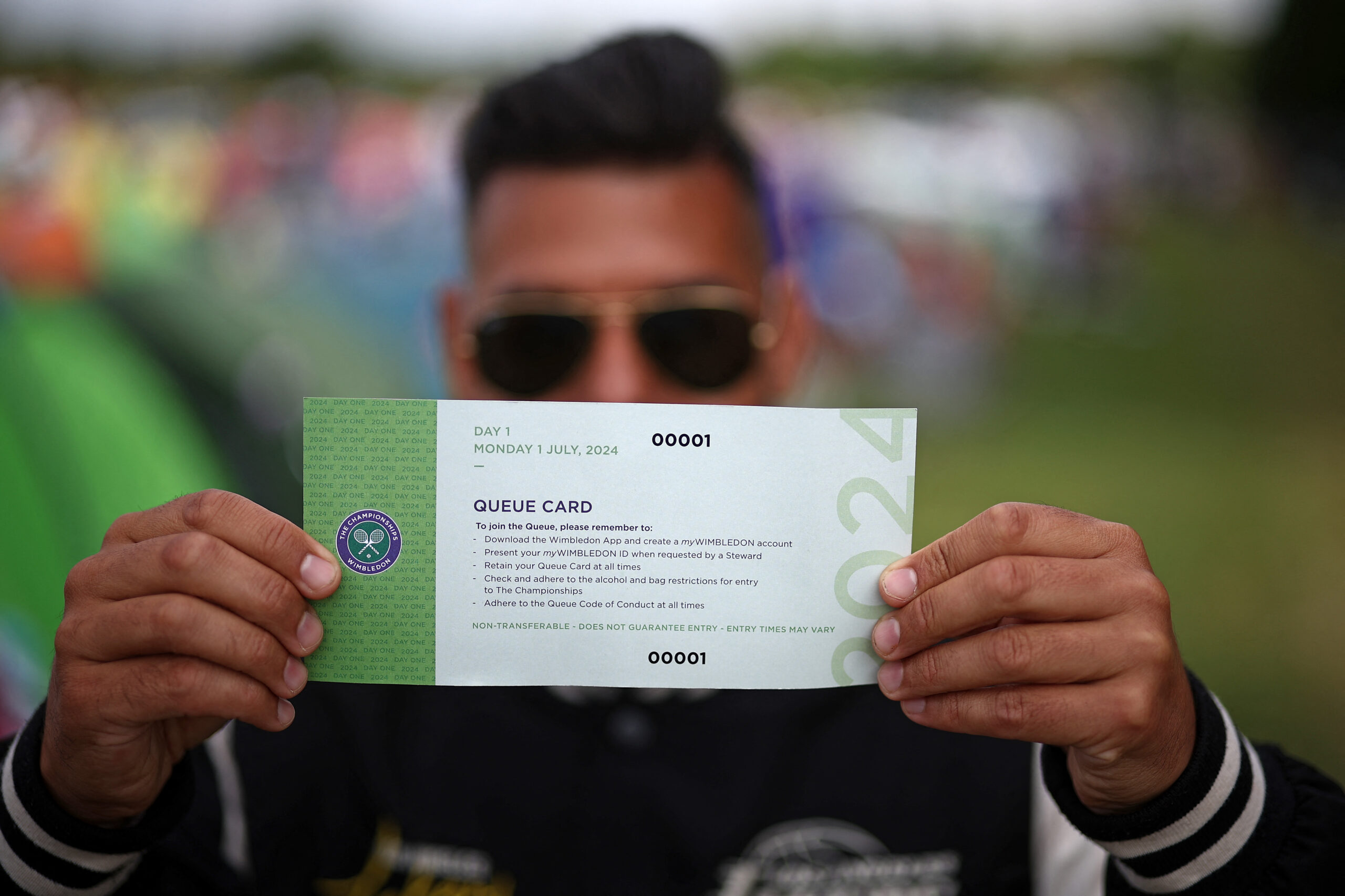
No other sporting event in the world has a tradition quite like The Queue. Every day of The Championships, thousands of tennis fans line up outside the All England Club to buy show-court tickets at face value — many of them camping overnight in a London park, pitching tents in a meadow a quarter-mile from Centre Court, and waiting for hours or days in conditions that range from sunburnt summer afternoons to soaking rain. They do this voluntarily. They consider themselves lucky.
The Queue is, in a sense that is genuinely unique among major sporting events, the most democratic feature of the most exclusive tournament in tennis. Here is a complete guide to how it works, where it came from, what to expect if you join it, and why it has become as central to the Wimbledon experience as the strawberries, the white clothing, or the grass itself.
How The Queue Works
Every day of The Championships, the All England Club holds back a specific allocation of tickets — not sold through the public ballot, not given to corporate hospitality, not reserved for debenture holders — and makes them available exclusively to people who join The Queue in person. The numbers, as of recent Championships:
- Approximately 500 Centre Court tickets, available every day of the tournament except the last four days (the men’s and women’s quarter-finals, semi-finals, and finals are not available via The Queue)
- Approximately 500 No. 1 Court tickets, available every day
- Approximately 500 No. 2 Court tickets, available every day
- Thousands of Grounds Passes, available every day until allocation closes, giving access to the outer courts (Courts 3–18) and Henman Hill
Tickets are issued first-come, first-served according to position in The Queue. When you arrive, you are given a Queue Card with a five-digit number — your literal position in line. The card is non-transferable. One ticket per person, paid for in cash or by card when you reach the gates, at the same face-value prices charged through the public ballot.
In 2025, Centre Court tickets ranged from £75 on the early days of the first week to £315 in the second week. No. 1 Court tickets ranged from £40 to £210. Grounds Passes ranged from £20 to £30 depending on the day. These are extraordinary prices for what would be, on the secondary market, tickets worth many multiples of those figures.
Where to Queue: Wimbledon Park
The Queue forms in Wimbledon Park — a large public park directly across Church Road from the All England Club, with the main entrance roughly a quarter-mile walk from Centre Court. The park is open to queuers from early afternoon the day before play (typically around 2:00 pm), giving people time to pitch tents, settle in, and find their position in line before the long evening begins.
The Queue is managed by a dedicated team of Honorary Stewards — many of whom are British military veterans serving in this capacity at The Championships as a long-standing volunteer tradition. The stewards manage the line, enforce the rules, issue Queue Cards, and answer questions from the thousands of people who pass through the system each year.
Three points to note about Wimbledon Park itself:
- It is a grass field, which can be muddy when wet and dusty when dry
- There are basic toilets and food vendors on site, but no showers
- The atmosphere is sociable — many regulars come to The Queue specifically for the experience rather than just the tickets
The Rules of The Queue
The Queue is governed by a published code of conduct that the All England Club updates each year. Some of the rules are practical; some are quintessentially British in their attention to the etiquette of waiting:
You must stay with your tent or position. Leaving for more than 30 minutes risks losing your spot. Stewards conduct rolling checks; tents left unattended for too long are dismantled and removed. The 30-minute window is designed to allow trips to the toilet, to food vendors, or short walks — not to leave the park for hours and return expecting to retain your place.
No place-holding. You cannot reserve a place for a friend or family member who hasn’t yet arrived. Everyone who wants a Queue Card must be physically present.
Two-person tents only. Larger tents, gazebos, awnings, and any structures that obstruct the layout of The Queue are prohibited. The two-person limit is enforced.
No barbecues, no smoking, no loud music after 10:00 pm. The Queue is in a residential area, and the All England Club has obligations to its neighbours. Quiet hours are taken seriously.
Queue Cards are non-transferable. You cannot give your card to someone else, sell it, or hold it on behalf of another person. Each card belongs to the individual who received it.
One ticket per person. You can buy a single Show Court ticket or a Grounds Pass; you cannot buy multiple tickets for a group with one Queue Card.
Food deliveries are permitted but must be collected at the Wimbledon Park Road gate before 10:00 pm. Pizza delivery to The Queue is a long-standing tradition.
The rules are enforced rigorously but politely. Chief Steward James Mendelssohn, speaking to NPR in 2025, described the enforcement style: stewards know all the attempts to slip in or work around the rules, and they direct anyone trying to do so to the back of the line.
When to Arrive
The honest answer is: it depends entirely on what you want.
For a Grounds Pass on most days of the first week: arriving at the gates around 7:00 am on the morning of play is generally sufficient. The Queue moves quickly once the grounds open, and Grounds Passes are typically available throughout the morning.
For a Centre Court, Court 1, or Court 2 ticket on most days of the first week: you almost certainly need to camp overnight. Arriving in Wimbledon Park between 2:00 pm and 6:00 pm the day before play, pitching a tent, and spending one night in the park will usually put you among the first 500 in line — meaning a Show Court ticket is very likely.
For a Centre Court ticket on a particularly anticipated day — a defending champion’s match, a heavily hyped first-round draw, a Wimbledon return by a former champion — camping for two nights may be necessary. The Queue in these cases has been reported to start more than 40 hours before play begins.
For the second week: Show Court demand increases as the tournament progresses and the draw narrows to the best players. Centre Court tickets are not available via The Queue for the final four days at all, but No. 1 and No. 2 Court tickets remain available throughout, with demand correspondingly higher.
If you join The Queue and your Queue Card number suggests you may not get a Show Court ticket, stewards will tell you. They actively try to prevent people from queueing in vain — once they know how many tickets remain and how many people are still waiting, they will inform those near the cut-off line so they can decide whether to stay for a Grounds Pass or leave.
What to Bring
A practical packing list for an overnight stay in The Queue, drawn from regular queuers and the All England Club’s own guidance:
For camping:
- A two-person tent (the maximum permitted)
- Sleeping bag and roll mat, or an inflatable mattress for multiple nights
- Pillow
- Warm clothes for the night, even in summer (British nights can be cold)
- Rain gear, even if the forecast looks clear
For comfort:
- Folding chair (one per person)
- Picnic blanket
- Food and drink for the overnight stay (alcohol is permitted in moderation)
- Phone charger or portable battery
- Cash for vendors (cards are accepted but cash is faster)
For the practicalities:
- Identification (required when buying tickets)
- Bank card or cash for the ticket purchase
- A small daypack for entry to the grounds — large bags are restricted inside
A Left Luggage facility opens in Wimbledon Park at around 5:30 am each morning, allowing queuers to store overnight gear (tents, sleeping bags, larger bags) before walking into the All England Club for the day’s play. There is a small fee, with proceeds going to the upkeep of Wimbledon Park.
The Culture of The Queue
What turns The Queue from a logistical inconvenience into a Wimbledon tradition in its own right is the culture that has grown up within it over decades. Regulars return year after year, often forming friendships across multiple Championships. First-time queuers find themselves welcomed into the strange, communal world of camped tennis fans within hours of arriving.
A typical evening in The Queue involves picnics with strangers, shared bottles of Pimm’s, conversations about the day’s play, predictions about the next day’s draw, and — in characteristic British fashion — long, gentle complaints about whatever the weather happens to be doing. People bring guitars, board games, and small portable televisions. They watch ESPN footage of the day’s play on their phones from inside their tents while waiting for tickets to tomorrow’s. They cheer in the distance when something dramatic happens on Centre Court a quarter-mile away.
The Queue has its own social media presence — most notably the @viewfromthequeue account on X (formerly Twitter), which posts updates throughout the fortnight on Queue length, conditions, and the experience of being in it. The official Wimbledon app contains a Queue section with current information about position numbers and likely ticket availability.
For many regulars, the Queue is not the price of admission to Wimbledon. It is part of Wimbledon — sometimes, they will tell you, the best part.
The History of The Queue
The tradition of queueing for Wimbledon tickets dates to the 1920s, shortly after the move to Church Road in 1922. From the beginning, the All England Club committed to making a portion of show-court tickets available to ordinary people on the day of play — a deliberate counterbalance to the institution’s otherwise exclusive character.
Over the decades, The Queue evolved into an organised system with stewards, rules, a published code of conduct, and a culture of its own. The first formal Queue rules were posted in 1927, making the system one of the oldest continuously documented traditions at the All England Club.
The current system — Queue Cards with five-digit numbers, the dedicated 30-minute rule, the no-place-holding policy — has been refined over many years of practice and is now stable enough that veterans can describe the experience to first-time queuers with reasonable certainty about what to expect.
The All England Club has consistently defended The Queue against the commercial pressures that would, at most equivalent events, have replaced it with dynamic pricing, online release windows, or aggressive secondary-market arrangements. The Queue exists because Wimbledon believes it should exist — a belief that has, in the modern era of sports ticketing, become increasingly distinctive.
What The Queue Represents
The Queue is the most democratic feature of one of the most exclusive sporting institutions in the world. It exists because the All England Club has chosen, year after year, to set aside a substantial number of premium seats and make them available to anyone willing to wait in a London park for the privilege.
This is not a small thing. The Queue’s approximately 1,500 Show Court tickets per day — 500 each for Centre Court (most days), No. 1 Court, and No. 2 Court — represent revenue the All England Club explicitly forgoes. Those same tickets, sold through corporate hospitality packages or via dynamic pricing on a secondary platform, would generate substantially more money. The Club has chosen, repeatedly and against the prevailing commercial logic, to leave that revenue on the table.
In doing so, the Club has produced something that no other major sporting institution offers: a structural guarantee that ordinary tennis fans with no special connections, no significant disposable income, and no advance preparation beyond a sleeping bag and a willingness to wait can attend the most prestigious tennis tournament in the world. As Chief Steward James Mendelssohn put it: this is the only Grand Slam in the world where a true tennis fan can be guaranteed of getting tickets for Centre Court.
That guarantee — practical, reliable, and maintained year after year — is what makes The Queue more than a quirky tradition. It is the institution’s most concrete commitment to the idea that Wimbledon is not just for those who can afford it.
The Bottom Line
The Queue is the most British tradition in the most British of sporting events — a literal line of people, governed by published rules of etiquette, managed by volunteer stewards, sustained by the willingness of strangers to share their picnic blankets and their wine, and built on the All England Club’s commitment to a kind of access that no other sport at this level reliably provides.
It is also, by widespread agreement of those who have experienced it, one of the most genuinely enjoyable ways to attend a major sporting event anywhere in the world. The cost is a tent, a sleeping bag, and a few hours or a few days of patience. The reward is a seat on Centre Court, the company of fellow tennis enthusiasts from around the world, and the satisfaction of having participated in a tradition that has shaped the experience of Wimbledon for nearly a century.
The Queue is, in every sense, part of the tournament. To have queued for Wimbledon is to have understood something about Wimbledon that no debenture-holder or corporate hospitality guest will ever quite grasp