

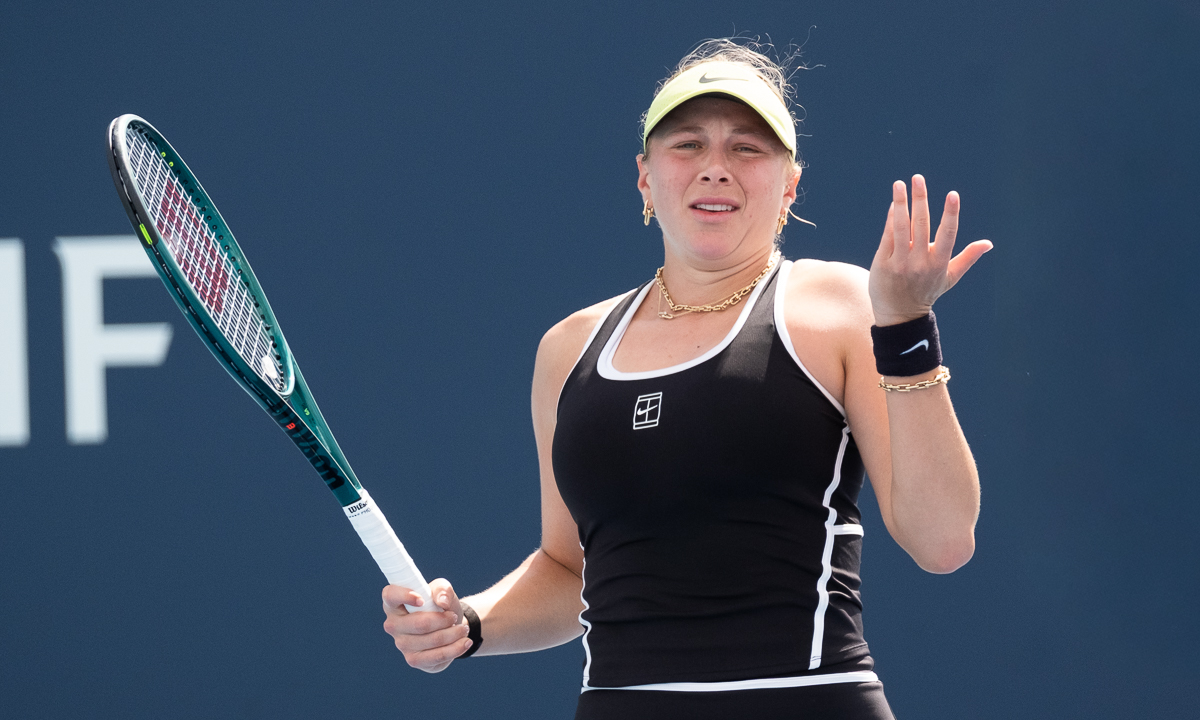
Amanda Anisimova’s road to Roland Garros is narrowing by the week. The American world No. 6 withdrew from the Internazionali BNL d’Italia in Rome on Thursday with a left wrist injury, less than an hour before her scheduled second-round meeting with Jelena Ostapenko.
It was her third consecutive withdrawal of the clay swing, after Charleston in late March and Madrid two weeks ago, and it leaves the 24-year-old without a competitive match since her fourth-round exit at the Miami Open.
The picture in Paris. Roland Garros begins on 24 May, and Anisimova is not entered in either of the WTA’s pre-tournament tune-ups. She has not been listed for the Internationaux de Strasbourg (17–23 May) or the Grand Prix Lalla Meryem in Rabat (18–23 May), the final scheduled clay events before the year’s second major.
Barring a wildcard appearance that has not been signaled, her opening match in Paris would be her first competitive outing in close to two months — and her first on clay this year.
The injury timeline. Anisimova has been managing the wrist since Miami, where she reached the round of 16 before pulling out of Charleston with what was initially described as an undisclosed issue picked up in Florida.
The Madrid withdrawal in late April was attributed publicly to wrist trouble, and Rome confirmed the pattern. She had travelled to the Foro Italico, trained on site, and was at the venue ahead of the Ostapenko match before the call was made.
The tournament’s statement on Thursday wished her a speedy recovery; no return-to-play timeline has been issued by her team.
The points she’s defending. Anisimova reached the fourth round at Roland Garros in 2025 before falling in straight sets to world No. 1 Aryna Sabalenka, a result worth 240 ranking points.
With nothing accumulated on the European clay swing this year, those points are now the only floor under her ranking through the French Open, and the No. 6 position will come under pressure if her Paris run is short or curtailed by the wrist.
A coaching change in the background. Compounding the on-court uncertainty is an off-court reset. Soon after Miami, Anisimova confirmed the end of her coaching partnership with Hendrik Vleeshouwers, the Dutch coach who had guided her through a breakthrough 2025 that included two Grand Slam finals and WTA 1000 titles in Doha and Beijing.
The split has not been followed by a publicly named replacement, and the player has been preparing for the clay swing without the structure of a settled team.
The competitive question. The harder issue is match readiness rather than fitness alone. Players returning to clay after long layoffs typically lean on the surface’s slower bounce to rebuild rhythm, and most of the Roland Garros contenders will arrive in Paris with double-digit match counts on the dirt.
Anisimova, if she plays, will not. Her draw, scheduling, and any practice-set form in the days before the tournament will all be heavily scrutinised — as will any further update from her team in the fortnight that remains.
Looking ahead. Two weeks is a usable window for a wrist issue that has been managed rather than operated on, and Anisimova’s clay pedigree — a French Open semi-final as a 17-year-old in 2019 — gives her a baseline of comfort on the surface that some of her hard-court-favoring rivals lack.
But the calendar does not flex. Roland Garros begins on 24 May, and unless there is a late entry in Strasbourg or Rabat, her first match of the European clay season will be on Court Philippe-Chatrier or one of its neighbors, against a fully match-tight opponent.
Whether she arrives in Paris match-fit, or simply in Paris, is now the question that will shape the first week of the women’s draw.