

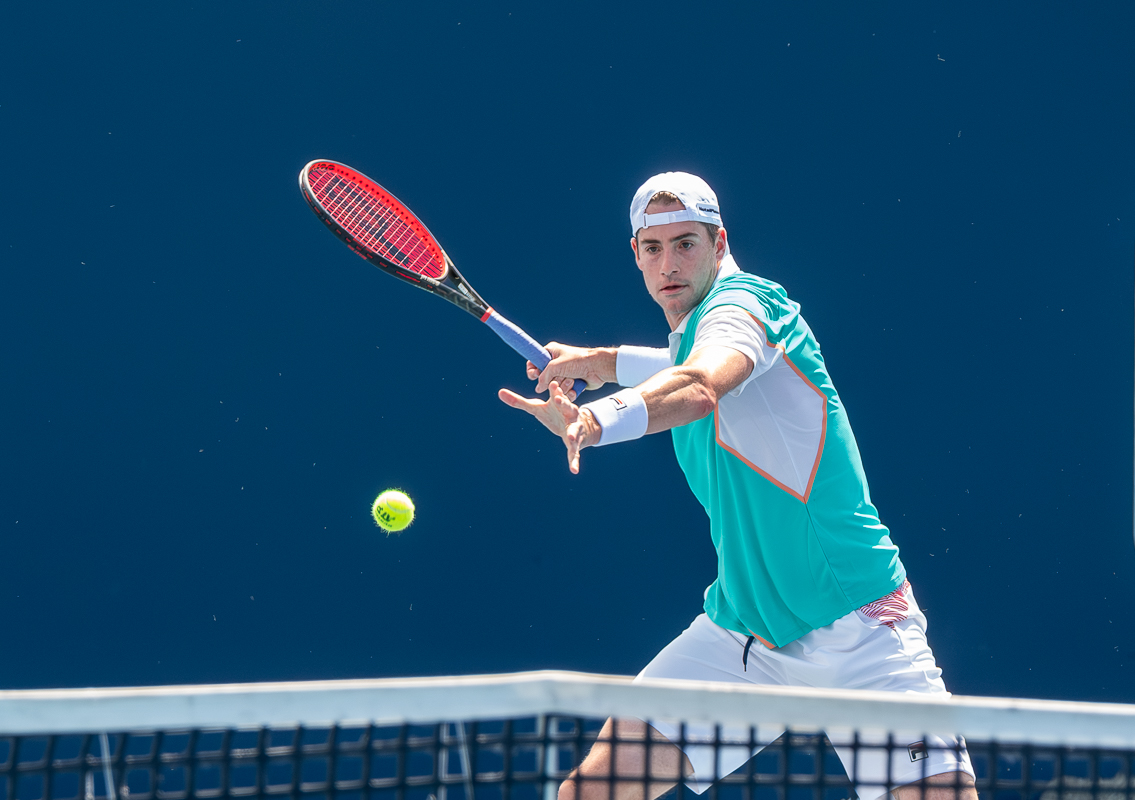
On the morning of June 22, 2010, John Isner and Nicolas Mahut walked onto Court 18 at Wimbledon for a first-round match that nobody expected to remember. Isner was an American ranked 23rd in the world — a big server with a powerful game but no particular Grand Slam pedigree.
Mahut was a French qualifier ranked 148th, known primarily as a doubles specialist whose singles results had never placed him among the sport’s elite. The match was scheduled on one of Wimbledon’s smaller outside courts, away from the main show courts where the tournament’s featured matches were played.
Three days later, after eleven hours and five minutes of total playing time spread across three interrupted days, the match finally ended. The final score — 6–4, 3–6, 6–7, 7–6, 70–68 — contained a fifth set so extraordinary that it has its own entry in the Guinness World Records, its own permanent scoreboard on Court 18, and a place in tennis history that will almost certainly never be displaced.
The Isner-Mahut match is not simply the longest match ever played. It is one of those rare sporting events that transcended its result entirely and became something the sport will carry permanently.
How It Started
The match began on June 22, a Tuesday, and proceeded normally through its first four sets. Isner won the first, Mahut the second, Mahut won a tiebreak in the third set, Isner won a tiebreak in the fourth. After four sets the score was level at two sets each — an entirely routine Grand Slam first-round situation with nothing to suggest what was about to happen.
The fifth set began and both players held serve. Then they held again. And again. At Wimbledon in 2010, the rules did not require a tiebreak in the final set — the set would continue until one player led by two games, however long that might take. Most fifth sets at Wimbledon resolved within a few games of reaching equality. This one did not.
Play was suspended at 59–59 on the first day due to darkness. It resumed the following morning and was suspended again at 59–59 — the same score — when rain interrupted play. The match resumed for the third time on June 24, and Isner finally broke Mahut’s serve for the first time in the entire fifth set to lead 70–69, then served out the match at 70–68.
The fifth set alone lasted eight hours and eleven minutes — longer than most complete tennis matches. It contained 138 games. It contained more aces — from both players combined — than any other set in Grand Slam history.
It was played across parts of three separate days by two players who were simultaneously breaking records, managing their own physical and psychological limits, and finding reserves of competitive resilience that neither had previously been asked to demonstrate.
The Records That Fell
The Isner-Mahut match broke records that had previously seemed comfortably beyond the reach of any single competition. Some of those records are worth examining specifically because they illustrate just how far beyond normal competitive parameters the match extended.
Longest match in tennis history: 11 hours and 5 minutes of total playing time, spread across three days. The previous record was a six-hour match. The Isner-Mahut match nearly doubled it.
Longest set in tennis history: The fifth set lasted 8 hours and 11 minutes and contained 138 games. The previous record for a single set was 24 games. The Isner-Mahut fifth set was nearly six times longer.
Most games in a match: 183 games total. The previous record was 112.
Most aces in a match: Isner served 113 aces across the full match — a record for any single match in professional tennis history. Mahut served 103. Their combined total of 216 aces in a single match has never been approached.
Most aces in a single set: Both players’ fifth-set ace counts individually exceeded the previous record for a complete match.
These records are not simply statistics. They are markers of a match that operated in an entirely different competitive register from anything that had previously been recorded — a match that extended so far beyond normal parameters that the records it broke were not close calls but comprehensive redefinitions of what a tennis match could contain.
What Both Players Were Experiencing
The human dimension of the Isner-Mahut match — what both players were experiencing physically and psychologically as the fifth set extended through its second, third, and fourth hours — is as remarkable as the statistical record it produced.
Professional tennis players are among the best-conditioned athletes in the world, but no professional athlete is conditioned specifically for the demands of an eight-hour set. Both Isner and Mahut were managing physical depletion that went beyond normal match fatigue — the progressive breakdown of muscle function, coordination, and concentration that extended physical effort eventually produces in any human body.
They were also managing the psychological reality of competing indefinitely, with no clear end point, in a context where winning required not just maintaining their own performance but waiting for the opponent to make an error that the competitive circumstances were progressively making more difficult.
The serving statistics tell part of the physical story. Both players maintained their serves through most of the fifth set — not because they were fresh but because their serves were so naturally powerful that even significantly depleted physical states produced deliveries that the opponent could not consistently return.
Isner’s serve, in particular, was functioning as a physical survival mechanism — each ace or service winner was a point won without the physical cost of a baseline rally, a form of competitive conservation that the fifth set’s extreme length made increasingly valuable.
The psychological dimension was equally extraordinary. Neither player was competing in the abstract against a standard of excellence — they were competing against each other, in real time, with the knowledge that any moment of reduced concentration or competitive intensity could be the moment their opponent found the break that ended it.
The ability to sustain that level of competitive focus across eight hours — after two previous days of competition, after the records had already been broken and the match had already moved into the realm of the historically unprecedented — represents a form of mental resilience that very few athletes have been asked to demonstrate.
The Role of the Crowd
One dimension of the Isner-Mahut match that is easy to overlook in the statistical context is the role of the Court 18 crowd — which grew progressively larger and more engaged across the match’s three days as word spread through Wimbledon and then through the global tennis media that something historic was happening on an outside court.
Court 18 is one of Wimbledon’s smaller venues — capacity measured in hundreds rather than thousands, with standing spectators lining the banks and pathways around the court.
By the second and third days of the match, the crowd had grown beyond what the court was designed to accommodate, with spectators pressing in from every available vantage point and the atmosphere shifting from the polite attentiveness of a routine first-round match to something closer to what major tournament finals produce.
The crowd’s engagement with the match was not simply voyeuristic interest in witnessing a record. It was genuine competitive investment in two players who were demonstrating something about resilience and competitive will that transcended their rankings, their seedings, and the first-round context of the match.
Court 18 became, for three days, the most important court at Wimbledon — more watched, more discussed, and more emotionally charged than any of the show courts where the tournament’s featured players were competing.
Both Isner and Mahut have described the crowd’s response as a sustaining force during the match’s most difficult stretches — a recognition that transcended the competitive result and acknowledged what both players were achieving simply by continuing to compete at the level the match required.
What Happened After
The immediate competitive aftermath of the Isner-Mahut match was anticlimactic in the way that all aftermath is — Isner, having spent eleven hours winning the first round, lost his second-round match to Thiemo de Bakker in straight sets the following day.
The physical depletion of the longest match in tennis history left him with insufficient recovery time to compete fully in his next encounter. The competitive logic of that outcome was entirely predictable.
The longer-term aftermath was more significant. Both players received standing ovations when they returned to Wimbledon in subsequent years — a recognition that the match had created a permanent bond between them and the tournament’s audiences that their subsequent competitive results could neither create nor diminish.
Wimbledon installed a permanent scoreboard on Court 18 commemorating the match’s final score — a tribute that acknowledged the match as part of the tournament’s permanent history rather than simply an exceptional result in a single year’s draw.
Isner and Mahut met again at Wimbledon in 2011 — in the first round, on the same Court 18 — in what felt like either cosmic coincidence or deliberate scheduling. Isner won again, this time in a conventional match, the reunion producing its own wave of media attention that illustrated how completely the 2010 match had entered tennis’s collective memory.
Mahut went on to have a successful doubles career — reaching the world doubles number one ranking and winning multiple Grand Slam doubles titles — that represented a different kind of professional success from the one the 2010 match had briefly suggested. His legacy in the sport is inseparable from a first-round singles loss that he will be remembered for more completely than most players are remembered for their greatest victories.
The Rule Change It Prompted
The Isner-Mahut match was the most prominent specific impetus for a rule change at Wimbledon that had been discussed but not implemented before 2010’s extreme illustration of what the traditional final-set format could produce.
Wimbledon introduced a final set tiebreak at 12–12 beginning with the 2019 tournament — a change that was directly motivated by the competitive and logistical problems that the Isner-Mahut match had made impossible to ignore.
The 2010 match had demonstrated that the traditional advantage-game final set format was not merely a competitive curiosity — it was a potential operational crisis for a tournament that needed to manage its schedule, its broadcast commitments, and its physical demands on players within reasonable parameters.
The 12–12 tiebreak rule — which was used for the first time in the 2019 Wimbledon final between Djokovic and Federer — represented Wimbledon’s acknowledgment that the match had exposed a structural vulnerability in the tournament’s rules that required a specific institutional response.
The Isner-Mahut match is therefore not just a historical curiosity or a record holder — it is the direct cause of a rule change that altered how the sport’s most prestigious tournament is decided.
The Australian Open and Roland Garros had introduced final set tiebreaks before Wimbledon did — the US Open had never played advantage final sets in the Open Era — and the sport’s eventual convergence on the match tiebreak at 6–6 in the final set at Grand Slams was accelerated by the specific lesson the Isner-Mahut match provided.
A match that began as a routine first-round encounter ultimately changed the rules of the sport’s most important events.
Why the Match Endures in Memory
The Isner-Mahut match endures in tennis memory for reasons that go beyond the records it set and the rule changes it prompted. It endures because it demonstrated something about tennis — and about competitive sport more broadly — that no normal match could have illustrated.
It demonstrated that the competitive will to continue can exceed any reasonable expectation of what physical endurance allows. Both players were operating beyond the parameters of normal athletic performance by the final stages of the fifth set — beyond fatigue, beyond the point where the physical body should have been able to sustain the technical demands of professional tennis.
They continued anyway. That continuation, and the quality they maintained while continuing, was a statement about what competition can ask of competitors and what competitors can give.
It demonstrated that tennis’s individual format — the complete absence of the team support structures that other sports provide — creates a specific kind of competitive solitude that has no parallel in major team sports.
Both players faced the physical and psychological demands of the match entirely alone, managing their own physical states, their own competitive focus, and their own psychological responses to circumstances that no previous player had encountered. The endurance required was not just physical but fundamentally individual.
And it demonstrated that the sport’s most memorable moments are not always produced by its most celebrated players in its most prominent matches. Court 18 in 2010 produced something that Centre Court at Wimbledon, for all its history, has never produced — a match so extreme in its competitive demands, so far beyond the normal parameters of what the sport asks of its participants, that it became immediately and permanently historic.
The scoreboard on Court 18 that records the final score — 70–68 — is there because Wimbledon recognized immediately that what happened on that court deserved permanent acknowledgment. The match will be remembered as long as tennis is played.
Part of the Tennis History series. Previous: The Most Shocking Upsets in Grand Slam History. Next: The 2008 Wimbledon Final — Why It Is Called the Greatest Match Ever Played.