

The four Grand Slam tournaments are the fixed points around which professional tennis organizes itself. They are the events that define careers, establish legacies, and generate the sport’s most enduring narratives.
Winning one is the benchmark of genuine greatness. Winning all four is the rarest achievement in the sport. And winning all four in a single calendar year — the Grand Slam — has been accomplished only twice in men’s tennis history and once in women’s.
But the Australian Open, Roland Garros, Wimbledon, and the US Open did not arrive in the world as the global sporting spectacles they are today. Each began as a modest national championship, organized by a domestic tennis association for a small field of local players, with no prize money, no television coverage, and no conception of the international institution it would eventually become.
Understanding how each of the four majors was founded — the specific historical circumstances, the individuals involved, and the paths each event took from national championship to global institution — is essential context for understanding what the Grand Slams represent in the history of the sport.
What Makes a Grand Slam a Grand Slam
Before examining each tournament’s individual history, it is worth establishing what the term “Grand Slam” actually means and where it comes from — because the concept is younger than the tournaments themselves.
The four tournaments that constitute the Grand Slam — Wimbledon, the US Championships, the French Championships, and the Australian Championships — all predate the term by decades.
They were established independently, run by separate national organizations, and did not collectively acquire the Grand Slam designation until 1938, when the American sportswriter Allison Danzig used the term in the New York Times to describe Don Budge’s achievement in winning all four major championships in a single calendar year.
Budge had won Wimbledon and the US Championships in 1937 and completed his sweep of all four in 1938 — the first player ever to hold all four major titles simultaneously.
The term itself was borrowed from contract bridge, where a grand slam refers to winning all thirteen tricks in a hand — the maximum possible achievement within the game’s structure. Applied to tennis, it described the maximum possible achievement within the structure of the major championships: winning all four in a single year.
The tournaments did not become collectively known as the Grand Slams until the term entered common usage to describe what Budge had done, and the concept of the Grand Slam as a distinct collective achievement is therefore inseparable from the individual who first accomplished it.
Wimbledon: The First and Most Prestigious
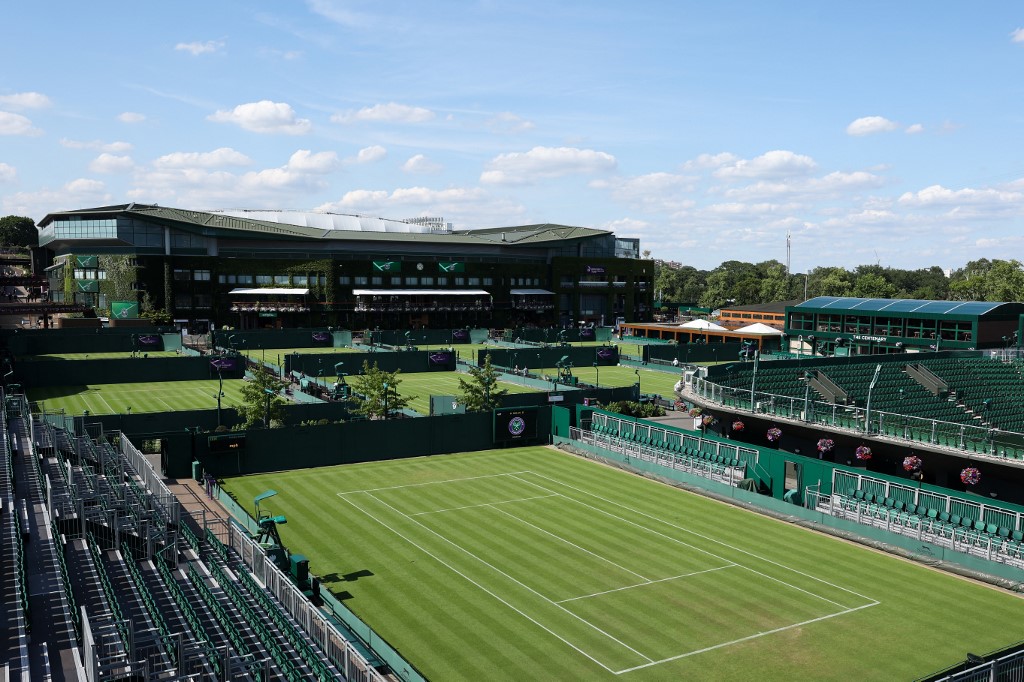
Wimbledon is the oldest of the four Grand Slams and the only one still played on the surface — grass — for which tennis was originally designed. Its history begins with the All England Croquet Club, founded in 1868 on four acres of land in the London suburb of Wimbledon.
The club added lawn tennis to its activities in 1875, initially as a minor addition to its primary croquet offering. Within three years, lawn tennis had become so popular that the club reorganized around it, changing its name to the All England Croquet and Lawn Tennis Club and organizing the first lawn tennis championship in 1877.
The 1877 championship was a deliberately structured event — the club’s committee drew up rules that modified and standardized Walter Wingfield’s original lawn tennis specifications, establishing the rectangular court, the net height, and the scoring system that, with minor modifications, govern the sport today.
Twenty-two players entered. The final was postponed by a day because of rain — establishing a weather-related tradition that Wimbledon has maintained ever since — and Spencer Gore won the title, defeating William Marshall in straight sets.
The early Wimbledon championships were amateur events in every sense. Players received no prize money — the silver challenge cup was the trophy, and the winner’s name was engraved on it for permanent recognition. The event was governed entirely by the All England Club, which set the rules, managed the entry, and controlled every aspect of the competition.
The club’s autonomy from external governing bodies — which it has jealously maintained throughout its history — is one of the defining institutional features of Wimbledon and a source of ongoing tension with the ATP and the International Tennis Federation.
Women’s competition was added in 1884, with the first women’s champion being Maud Watson. The doubles events followed shortly after, establishing the full complement of singles and doubles competitions that Wimbledon still runs today.
The move to the current Church Road site — where Wimbledon still takes place — happened in 1922, when the original Worple Road grounds became too small for the growing crowds.
Wimbledon’s transition from the leading national championship to the world’s most prestigious tennis tournament happened gradually through the late nineteenth and early twentieth centuries as international players began competing and its results began to carry international significance.
By the time the Open Era began in 1968, Wimbledon’s status as the sport’s primary institution — the oldest, most traditional, and most socially prestigious major — was unquestioned.
The US Open: From Newport to New York
The United States National Championships — which would eventually become the US Open — began in 1881 at the Newport Casino in Newport, Rhode Island, an exclusive resort facility patronized by the American Gilded Age elite.
The tournament was organized by the United States National Lawn Tennis Association, which had been founded the same year to govern the sport in America, and it was restricted to members of clubs affiliated with that association — a limitation that effectively confined the early championship to the American social elite.
The first US Championship was won by Richard Sears, who would go on to win the title seven consecutive times between 1881 and 1887 — a dominance that has never been equaled in the tournament’s history.
The early Newport years established the US Championship as the premier American tennis event but not yet as an international competition of the first rank — European players rarely crossed the Atlantic to compete, and the field was primarily American.
Women’s competition at the US Championships began in 1887 at a separate location — the Philadelphia Cricket Club — and was run as a distinct event from the men’s championship for many years before the two events were consolidated into a single national championship. Ellen Hansell won the first women’s title.
The tournament moved from Newport to the West Side Tennis Club in Forest Hills, New York in 1915 — a relocation that reflected both the growth of the event and the shift in American tennis’s center of gravity from the exclusive Newport resort scene to the New York metropolitan area. Forest Hills would host the US Championships for decades, becoming synonymous with American tennis through the amateur era.
The transformation from national championship to modern Grand Slam required two further major changes. In 1968, the US Open became the first Grand Slam to embrace the Open Era — the first major to offer prize money and admit professional players — making it the pioneer of the modern tournament structure. And in 1978, the tournament moved to the USTA National Tennis Center in Flushing Meadows, New York, where it has been played ever since on hard courts that replaced the grass and clay surfaces of the earlier years.
The US Open’s identity — brash, commercial, urban, loud, and proudly accessible in contrast to Wimbledon’s exclusivity — was established through these transitions. The night sessions under the lights at Arthur Ashe Stadium, the New York crowd’s vocal and partisan engagement, and the hard court surface that rewards a different style of play from the other majors all contribute to an event that is genuinely distinct in character from its three counterparts.
Roland Garros: From Club Championship to Clay Court Cathedral
The French Championships have the most unusual origin story of the four Grand Slams — beginning as an explicitly closed national championship that excluded foreign players, before being forced open by the commercial and competitive pressures of the international tennis community.
The French Championships were first played in 1891 at the Racing Club de France in Paris, open only to members of French tennis clubs. This restrictive membership requirement meant that international players — including many of the best in the world — could not compete, limiting the championship’s international significance through its early decades. The tournament was won consistently by French players who did not need to demonstrate their quality against the broader international field.
The opening of the French Championships to international players came in 1925, when the tournament was restructured as an international event and players from any nation were permitted to enter.
The four years immediately following — 1926 through 1932 — were dominated by a group of French players known as the Four Musketeers: René Lacoste, Henri Cochet, Jean Borotra, and Jacques Brugnon. Their dominance of the newly international French Championships in the late 1920s and early 1930s established the tournament as a genuine international competition while also cementing the French public’s emotional investment in it.
The tournament’s current name and location derive from a moment of national pride that had nothing to do with tennis. Roland Garros was a French aviator — the first person to fly solo across the Mediterranean Sea, in 1913 — who was killed in aerial combat during the First World War.
When France needed to build a new tennis stadium to host the Davis Cup in 1928 — the year France’s Four Musketeers were defending their Davis Cup title against the United States — the new facility was named in honor of Garros. The French Championships moved to the Stade Roland Garros the following year, and the tournament has been played there ever since.
The clay courts at Roland Garros are unlike any other surface in professional tennis — a specific type of crushed red brick that produces the slowest and most physically demanding conditions at any Grand Slam.
The surface has made Roland Garros the spiritual home of clay court tennis and the tournament most associated with a specific style of play: grinding, topspin-heavy, endurance-dependent baseline tennis that rewards physical resilience and tactical patience over power and pace.
No tournament in tennis has a more distinctive competitive identity, and no surface dominates a single event as completely as clay dominates Roland Garros.
The Australian Open: The Remotest Major
The Australian Open has the most geographically isolated history of the four Grand Slams — a consequence of Australia’s distance from the centers of world tennis in Europe and North America that shaped the tournament’s development through most of the twentieth century and continues to give it a distinctive character today.
The Australasian Championships — the tournament that would eventually become the Australian Open — were first held in 1905 at the Warehouseman’s Cricket Ground in Melbourne, organized by the Lawn Tennis Association of Australasia.
The term Australasian reflected the inclusion of New Zealand in the original competition structure — the tournament was a regional championship for both countries, and New Zealand players competed alongside Australians for the title in the early years.
The first champion was Rodney Heath, an Australian who defeated Arthur Curtis in the final. Women’s competition began in 1922, significantly later than at the other three majors — a reflection of the tournament’s remoteness and the smaller population base from which it drew its early fields.
The tournament’s history through the first half of the twentieth century was shaped almost entirely by its geographical isolation. The cost and difficulty of traveling to Australia from Europe or North America meant that most of the world’s top players simply did not compete — the early Australasian championships were won almost exclusively by Australian and New Zealand players, and the international field remained thin through the amateur era.
This isolation paradoxically produced one of the most remarkable concentrations of tennis talent in any country in the sport’s history: Australia developed an extraordinary pipeline of world-class players through the mid-twentieth century — Jack Crawford, John Bromwich, Frank Sedgman, Lew Hoad, Ken Rosewall, Rod Laver, John Newcombe, and others — precisely because the domestic competition was so strong that quality players could develop entirely within the Australian circuit.
The tournament moved between cities in its early decades — Melbourne, Sydney, Adelaide, Brisbane, and Perth all hosted the championships at various points — before settling permanently in Melbourne in 1972. The current venue, Melbourne Park, was opened in 1988 and introduced the retractable roof over the main show court — now named Rod Laver Arena — that allowed the Australian Open to guarantee play regardless of weather for the first time.
The switch from grass to hard courts in 1988 was the most significant surface change in the history of any Grand Slam. The Australian Open had been played on grass through its entire history to that point — making it, along with Wimbledon, one of two grass court majors.
The transition to hard courts fundamentally changed the tournament’s competitive character, making it more hospitable to the baseline game and less dependent on the serve-and-volley tactics that grass had historically rewarded. The Rebound Ace hard court surface used from 1988 was replaced by Plexicushion in 2008 — a slightly faster and more consistent surface that remains in use today.
The Australian Open’s identity in the modern era — the “happy Slam,” as players have called it, reflecting its relatively relaxed atmosphere compared to the traditions and pressures of Wimbledon and Roland Garros — has been built through deliberate efforts to create an accessible, fan-friendly event in the southern hemisphere summer.
Its January positioning, its combination of day and night sessions, and its location in one of the world’s most livable cities have made it a genuinely popular event with players and fans alike, despite the travel demands its location places on the European and American players who form the core of the professional tour.
The Concept of the Grand Slam in Competitive History
The collective designation of these four tournaments as the Grand Slams — and the specific challenge of winning all four in a single calendar year — has produced some of the most remarkable competitive achievements in the sport’s history.
Don Budge’s 1938 Grand Slam — winning the Australian, French, Wimbledon, and US championships in a single year — was the achievement that defined the concept. Budge won all four without losing a set en route to any of the four titles — a level of dominance that has never been replicated in the calendar Grand Slam context.
Maureen Connolly became the first woman to win the calendar Grand Slam in 1953, winning all four majors at age eighteen — a performance that would have been the beginning of a long era of dominance had a horse riding accident not ended her career the following year. She won nine Grand Slam singles titles in total, all achieved before the age of twenty.
Rod Laver completed the calendar Grand Slam twice — in 1962 as an amateur and in 1969 as a professional — the only player in history to achieve the feat more than once and the only man to complete it in the Open Era.
His 1969 Grand Slam, won across all four surfaces including the first Open Era Australian Open, is widely considered the greatest single-season achievement in the history of men’s tennis.
Steffi Graf’s 1988 Golden Slam — winning all four Grand Slams and the Olympic gold medal in the same year — remains the most complete single-season achievement in the history of tennis. No player has won all five major titles available in a calendar year before or since.
How the Grand Slams Became What They Are Today
The transformation of the four national championships into global sporting institutions happened through the Open Era and the television age simultaneously — the two developments reinforcing each other to expand the commercial scale, international profile, and competitive significance of the majors beyond anything their founders could have imagined.
Prize money grew from the modest token amounts of the early Open Era to the tens of millions of dollars that Grand Slams offer today. Television audiences expanded from domestic broadcast reach to global distribution across every major market.
Player fields that once reflected the geography and transport limitations of the pre-aviation era became genuinely international, drawing the best players from every tennis-playing nation.
The physical infrastructure grew correspondingly. Wimbledon’s All England Club expanded its facilities while maintaining its historical character. The US Open moved to the vast USTA Billie Jean King National Tennis Center in Flushing Meadows.
Roland Garros expanded its footprint in Paris through multiple phases of construction. Melbourne Park grew around Rod Laver Arena to accommodate the Australian Open’s growing audience.
What remained constant through all of this expansion was the fundamental competitive structure — the singles and doubles draws, the best-of-five sets for men, the fortnight duration — that each tournament had established in its national championship origins.
The Grand Slams are simultaneously the most changed and the most unchanged events in professional tennis: transformed in commercial scale, global reach, and financial significance, but maintaining competitive formats and institutional identities that connect them directly to their nineteenth-century foundations.
The Grand Slams Today
The four Grand Slams collectively represent the pinnacle of professional tennis — the events where careers are defined, records are set, and the sport’s greatest rivalries reach their most consequential expressions.
Their combined history stretches from 1877 at Wimbledon through one hundred and forty years of competition, encompassing the amateur era, the Open Era, the television age, and the global professional sport that tennis has become.
Each major retains a distinct identity shaped by its origins, its surface, its location, and its institutional culture. Wimbledon’s grass and tradition. Roland Garros’s clay and physical demands. The US Open’s hard courts and New York energy.
The Australian Open’s summer heat and southern hemisphere timing. Together they constitute the architecture of professional tennis — the fixed points around which everything else in the sport is arranged.
Understanding their individual histories — where each began, how each evolved, and what each has contributed to the sport’s development — is the foundation for understanding what winning them means, why their records matter, and why the players who have dominated them are remembered the way they are.
Part of the Tennis History series. Previous: The History of Tennis — How the Sport Was Invented and Evolved. Next: How Professional Tennis Became Open — The Story of the Open Era.