

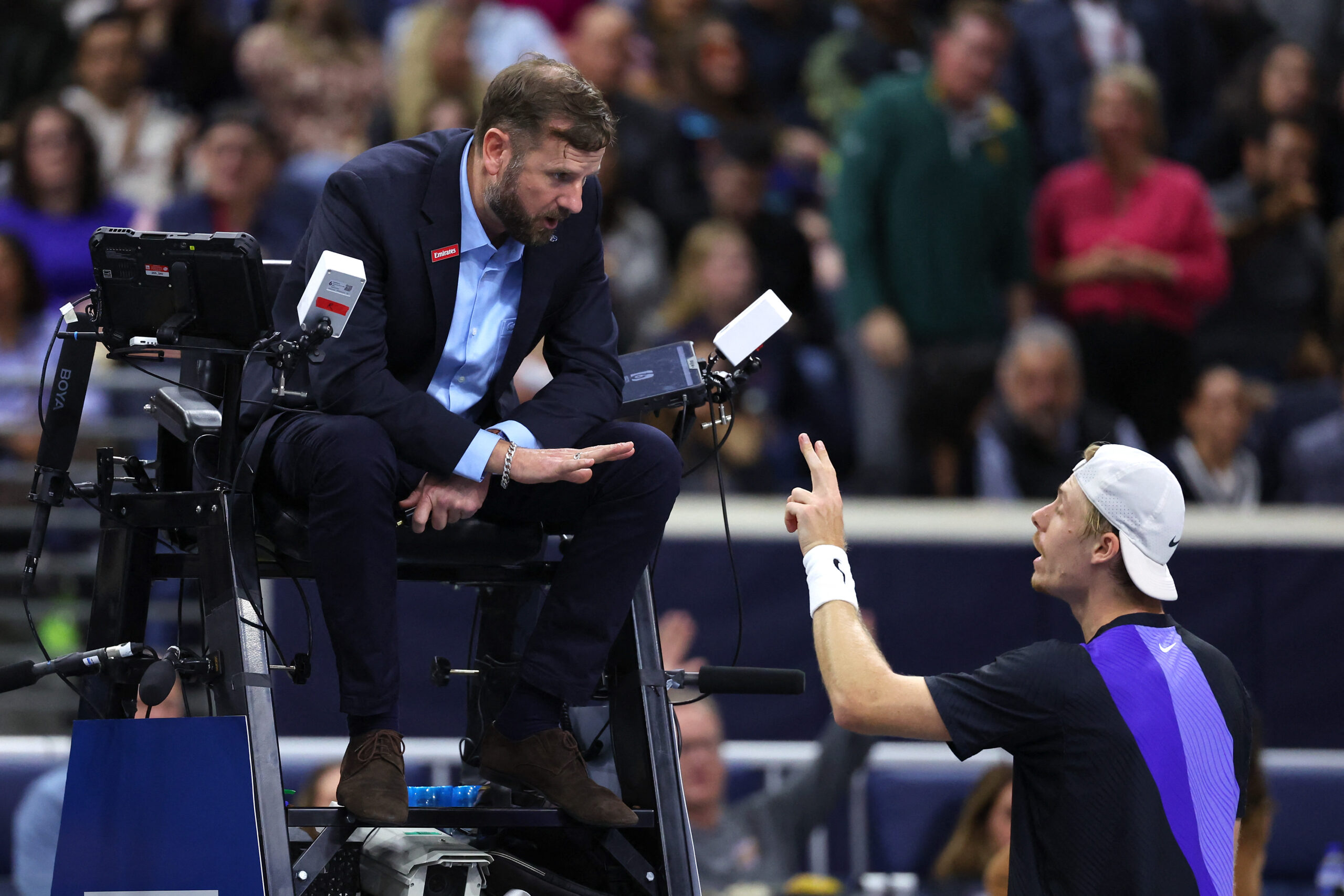
In the vast majority of professional tennis matches, the outcome is decided on the court. One player wins enough points, games, and sets to claim the match, the other accepts the result, and both move on. But tennis has a parallel mechanism for ending matches — and occasionally entire tournaments — that has nothing to do with the score. A player can be removed from a match entirely, not because they lost it but because of something they did or failed to do. That removal is called a default.
Defaults are rare enough that many casual tennis fans have never seen one. They are significant enough that when they do occur — particularly involving high-profile players at major events — they generate substantial controversy, debate about the rules, and lasting discussion about the standards of professional conduct the sport expects from its competitors. Understanding exactly what a default is, when it happens, and what follows helps clarify a part of professional tennis that its official rulebook governs in precise detail but that broadcast coverage rarely explains fully.
What a Default Actually Is
A default is the immediate termination of a match — or a player’s participation in a tournament — by the match officials, resulting in the defaulted player losing the match or being withdrawn from the event entirely. It is distinct from a retirement, where a player voluntarily withdraws from a match due to injury or illness and their opponent advances. A default is imposed on a player by the officials. The player does not choose it.
The practical effect of a default is identical to a loss: the defaulted player’s opponent advances, or in the case of a tournament default, the player is removed from the draw entirely. But the circumstances, the process, and the consequences that follow are entirely different from a standard competitive loss.
Defaults can occur at any point in a match — before it begins, during the warmup, after the first point, or deep into the fifth set. The stage at which a default occurs affects some of the practical consequences, particularly around prize money, but the essential mechanism is the same regardless of timing.
The Main Reasons a Player Gets Defaulted
Professional tennis’s rulebook — the Grand Slam Rulebook for major events and the ATP and WTA rulebooks for tour events — sets out the specific categories of conduct that can result in a default. They fall into several broad groups.
The Point Penalty System and Accumulated Violations
The most common pathway to a default in professional tennis runs through the point penalty system — a graduated structure of warnings and penalties that escalates with repeated violations and ultimately reaches default as its endpoint.
The system works as follows. A player who commits a code violation — racket abuse, ball abuse, visible obscenity, verbal abuse of an opponent or official, audible obscenity, or unsportsmanlike conduct — receives a warning on their first offense. A second violation in the same match results in the loss of a point. A third violation results in the loss of a game. A fourth violation — or any single violation severe enough to bypass the graduated structure — results in a default.
This escalating structure means that most defaults through the point penalty system are the endpoint of a sequence of violations rather than a single isolated incident. A player who has already received a warning and a point penalty is one violation away from a game penalty, and one further violation away from default. The proximity to default at that stage is known to the player, the officials, and typically the crowd — which gives the final violations before a default a particular tension.
The point penalty system is designed to give players the opportunity to correct their behavior before the ultimate sanction is applied. The graduated nature of the warnings is explicit — officials are not meant to default a player without working through the prior stages unless the conduct is severe enough to warrant bypassing them entirely.
Immediate Default for Severe Conduct
Some conduct is serious enough that the graduated point penalty system is bypassed entirely. A player who commits an act of sufficient severity — physical aggression toward an opponent, an official, a ball person, or a spectator; deliberate and direct abuse of an official; or conduct that the supervisor determines constitutes a serious threat to the safety or integrity of the match — can be defaulted immediately without prior warning or penalty.
This category of immediate default is the one that generates the most significant controversy when it occurs, because it involves a judgment call by the officiating team about the severity of conduct rather than a mechanical application of the graduated system. What constitutes conduct severe enough to warrant immediate default — as opposed to a standard warning — is a determination made in real time under pressure, and those determinations are not always universally accepted.
Time Violations and Failure to Be Ready
Players can also be defaulted for failure to appear on court within the required time after being called, failure to be ready to begin a match within the specified warm-up period, or persistent time violations that have escalated through the penalty structure. These defaults are rarer than conduct-related ones but they do occur, particularly in situations where a player’s preparation or warm-up has been disrupted and they are unable to take the court within the rules’ required timeframe.
Equipment and Uniform Violations
A player who refuses to comply with equipment or uniform regulations after being directed to do so by the supervisor can ultimately be defaulted, though this pathway to default is extremely rare in practice. Equipment and uniform issues are almost always resolved through discussion and accommodation before the situation reaches default territory.
Who Makes the Default Decision
The authority to default a player rests with the tournament referee or supervisor — not with the chair umpire alone. The chair umpire manages the point penalty system and applies warnings and point penalties within their authority, but a default requires the involvement of the supervisor, who is called onto the court when a situation reaches the threshold where default is being considered.
This distinction matters because it introduces a layer of senior oversight into the most consequential officiating decisions in professional tennis. A chair umpire who believes a player’s conduct warrants default calls the supervisor. The supervisor assesses the situation, reviews what has occurred, and makes the determination. In straightforward cases — a player who has accumulated the violations required to reach default through the standard system — the decision is largely mechanical. In more complex situations involving conduct severity judgments, the supervisor’s assessment is more subjective and more consequential.
In some cases, particularly at Grand Slams, a referee is also involved in the decision. The chain of authority ensures that defaults — especially immediate defaults for severe conduct — are not unilateral decisions by a single official made in the heat of the moment, but involve review by multiple senior officials before being applied.
What Happens Immediately After a Default
When a default is announced, the match ends immediately. The defaulted player’s opponent is declared the winner and advances in the draw. The defaulted player leaves the court.
What happens next depends on whether the default is a match default — removing the player from a single match — or a tournament default — removing the player from the entire event.
A match default in an early round results in the player’s elimination from the tournament at that stage, exactly as a competitive loss would. A match default in a later round — a semifinal or final, for example — results in the player’s opponent advancing to the final or claiming the title by default.
A tournament default is more serious. It removes the player from the entire event retroactively, meaning all their results in the tournament are voided and they are treated as if they did not compete. Tournament defaults are issued for the most serious conduct violations and for situations where a player’s behavior is determined to be incompatible with their continued participation in the event as a whole rather than just the match in which the violation occurred.
Prize Money and Ranking Points After a Default
The financial and ranking consequences of a default depend on the type and timing of the default.
A default costs the player considerably more than the match. Under ATP rules the customary penalty is forfeiture of ranking points and prize money for the entire tournament, not merely for the round in which the violation occurred. The Grand Slam Rulebook applies the same principle.
The 2020 US Open is the clearest illustration. The USTA’s statement confirmed that because Djokovic was defaulted, he would lose all ranking points earned at the tournament and be fined the prize money won there — the $250,000 attached to reaching the fourth round, forfeited in full.
The penalty is not beyond challenge. When Andrey Rublev was defaulted from the 2024 Dubai semi-final, he appealed and won. The ATP’s appeals committee found that the customary penalty — loss of ranking points and prize money for the entire tournament — would be disproportionate on the evidence in that case, and his points and prize money were restored. The appeal route exists, but total forfeiture is the starting position, not the exception.
The most serious conduct violations can carry financial penalties beyond the forfeiture of tournament earnings, assessed separately from the prize money question.
Additional fines for the conduct that led to the default are assessed through the tour’s disciplinary process, which runs parallel to and separate from the in-match officiating system. A player who is defaulted may subsequently face a disciplinary hearing that results in fines, suspension, or other sanctions depending on the severity and nature of the violation.
The Most Notable Defaults in Professional Tennis
The default that most tennis fans of the modern era know immediately is Novak Djokovic’s default from the 2020 US Open. Playing in the fourth round against Pablo Carreño Busta, Djokovic struck a ball in frustration after losing a game and accidentally hit a line judge in the throat with the ball. The line judge fell to the ground. After consultation between the chair umpire, the tournament referee, and other officials, Djokovic was defaulted from the match and the tournament.
The incident generated enormous discussion not because the default decision was widely disputed — the rules on striking a ball person or official are clear — but because of the specific circumstances: the absence of intent, the stature of the player involved, the stage of the tournament, and the fact that Djokovic had been widely expected to win the title. The default removed the world number one from a Grand Slam he had been on course to win, and the discussion it prompted covered everything from the proportionality of the sanction to the role of intent in conduct violations.
Other notable defaults in professional tennis history include Tim Henman’s default from the 1995 Wimbledon doubles for hitting a ball in frustration that struck a ball girl, and various lower-profile defaults through the accumulated violation pathway that have occurred at tour events across the sport’s history. Each incident, regardless of the player involved, reinforces the same fundamental principle: the rules apply to everyone, and the default mechanism exists precisely because the sport requires enforceable standards of conduct.
The Role of Intent in Default Decisions
One of the most persistent debates around defaults — particularly those involving balls or rackets that accidentally strike officials, ball persons, or spectators — concerns the role of intent. If a player did not mean to hit someone, should the sanction be the same as if they deliberately directed an object at a person?
The professional tennis rulebook does not require deliberate intent for a default to be issued in cases involving ball persons and officials. The rules are written to protect the safety of everyone on and around the court, and a ball struck in frustration that accidentally injures someone triggers the same protective response regardless of whether the player intended the outcome. The standard is not intent but result and circumstance.
This position is defensible on safety grounds — a rule that required proof of intent before applying sanctions for incidents involving ball persons and line judges would create significant practical and interpretive difficulties. But it also produces outcomes that feel disproportionate to some observers when a player clearly did not intend harm and the injury, if any, was minor.
The sport has not resolved this tension completely, and debates about the role of intent in default decisions recur every time a high-profile incident raises the question again. What is consistent is the official position: the rules apply as written, intent is not a mitigating factor for the default decision itself, and subsequent disciplinary processes can take context and intent into account when determining whether additional sanctions beyond the default are warranted.
Defaults in Team Competition
Defaults in team tennis — Davis Cup, Billie Jean King Cup, and other national team competitions — operate under slightly different rules and can have consequences that extend beyond the individual player to the team as a whole. A player defaulted from a rubber in a team tie forfeits that rubber, which affects the tie score and can determine which nation advances. In serious cases, a player’s default can result in their nation forfeiting the entire tie.
The team context adds a dimension to defaults that does not exist in individual competition — the player’s conduct affects not just their own result but their teammates’ competitive interests and their nation’s standing in the competition. This collective consequence is one reason that conduct standards in team competition are taken particularly seriously by captains and national federations.
What a Default Is Not
It is worth being precise about what a default is not, because the term is sometimes used loosely in broadcast and media coverage in ways that conflate it with related but distinct outcomes.
A default is not a retirement. A retirement is voluntary — the player chooses to withdraw, typically due to injury or illness, and their opponent advances. A default is imposed by officials against the player’s will. The three outcomes are set side by side in walkover vs retirement vs default.
A default is not a walkover. A walkover occurs when a player cannot take the court at all — typically due to injury before the match begins — and their opponent advances without play. The distinction from a default is that a walkover involves a player’s physical inability to compete rather than a conduct violation.
A default is not a disqualification from the sport more broadly. It is a match or tournament sanction. Broader disciplinary consequences — suspensions, additional fines, mandatory counseling — are assessed through separate processes after the fact and are not part of the default itself.
Why Defaults Matter Beyond the Individual Incident
Every default in professional tennis, however it occurs, is a reminder that the sport’s competitive framework rests on a foundation of enforceable standards. Prize money, ranking points, and competitive advancement are available only to players who compete within the rules — not just the technical rules of how the ball is struck and where it lands, but the conduct standards that govern how players behave toward officials, opponents, ball persons, and the event itself.
Those standards exist because professional tennis, like all professional sport, depends on the trust of its participants, officials, and audience. A sport in which conduct violations carried no meaningful consequence would be a different sport — one where the competitive environment could not be reliably maintained and where the people working closest to the players, including ball persons and line judges who are often young volunteers, would not be adequately protected.
The default mechanism is the sport’s clearest statement that competitive excellence and personal conduct are both expected — and that when the second fails seriously enough, the first no longer matters.
Related: How Tennis Tournaments Work — Draws, Seeds, and the Road to a Championship · Who Really Gets Tennis Wildcards · Withdrawal Rules in Professional Tennis: Deadlines, Fines and Player Obligations