

Every Grand Slam has a personality, but only one of them feels like arriving somewhere that exists outside of ordinary time. The Australian Open is a festival. The French Open is an examination. The US Open is a spectacle.
Wimbledon is something else entirely — a fortnight in which a private club in southwest London imposes its values on the entire sport, and the sport accepts them without complaint. Here is why Wimbledon feels different, and why that difference is felt by everyone who enters the grounds.
The Location Does Something to You Before You Arrive
Getting to Wimbledon is not like getting to any other Grand Slam. You take the District Line on the London Underground — one of the oldest metro lines in the world — to Southfields or Wimbledon station, and then you walk. Past Victorian terraces. Through quiet residential streets. Past front gardens where homeowners rent their driveways as car parks and sell cups of tea from card tables.
The approach to the All England Club does not feel like arriving at one of the world’s great sporting venues. It feels like walking into a particularly well-attended village fete.
This is not an accident. Wimbledon sits in SW19, a leafy, well-heeled suburb of London where tennis has been played since the 1870s. The All England Club is not an arena dropped into an urban landscape, like Arthur Ashe Stadium rising from the Flushing Meadows park infrastructure of Queens.
It is a private members’ club with manicured grounds, a clubhouse, and a Members’ Enclosure from which spectators have watched The Championships since 1877. The neighborhood has shaped the tournament, and the tournament has shaped the neighborhood. You feel it on the approach in a way you simply cannot replicate at any of the other three Slams.
Centre Court Is Smaller Than You Expect
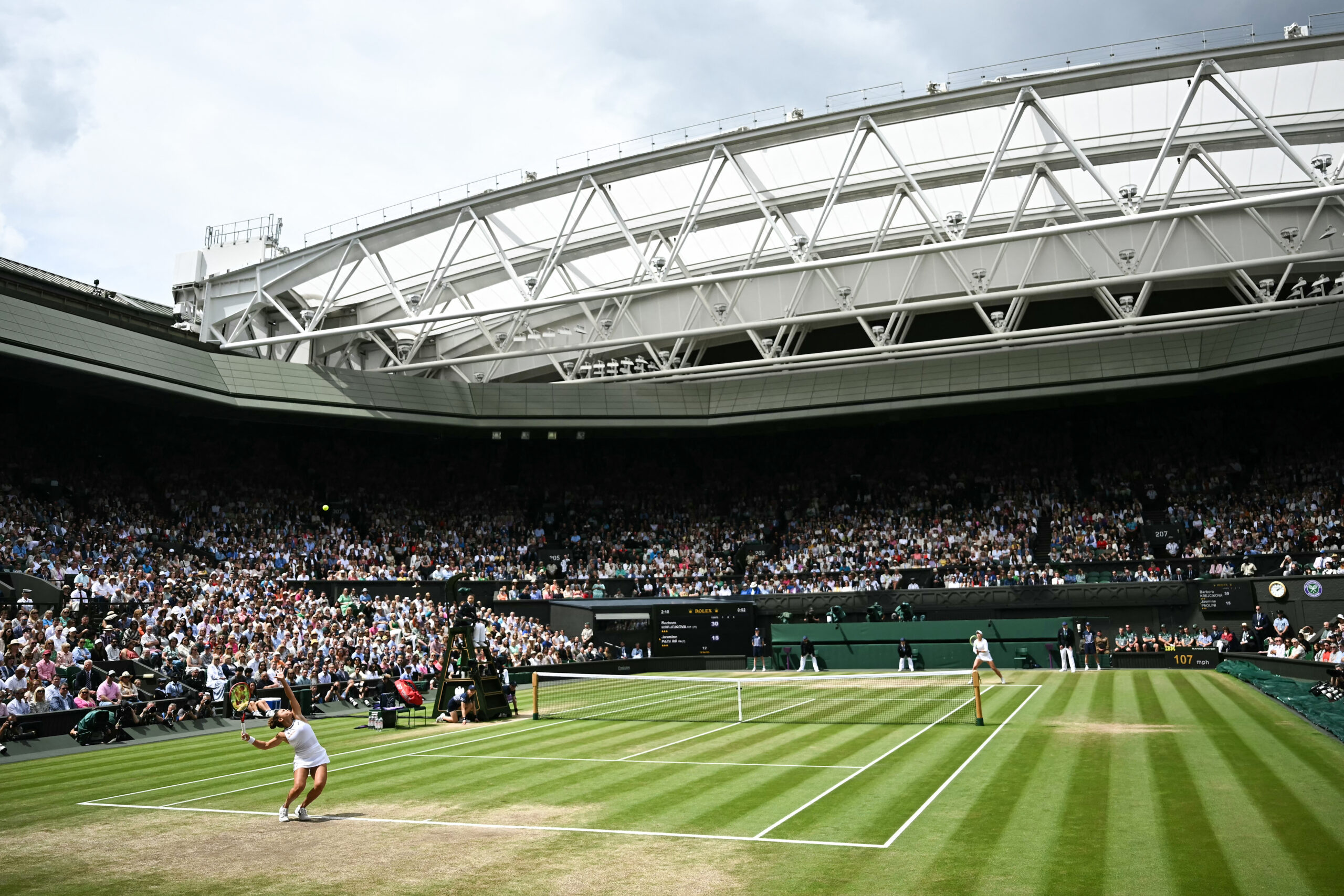
First-time visitors to Centre Court almost universally report the same surprise: it is more intimate than television suggests. The court holds just under 15,000 spectators — roughly 9,000 fewer than Arthur Ashe Stadium in New York, and the reason Centre Court feels so different from the US Open’s main arena.
The stands wrap tightly around the playing surface. The upper tier is close enough that you can read a player’s expression clearly. The grass is, from almost any seat in the house, strikingly present — a luminous rectangle of green that draws the eye in a way that blue hard courts and red clay simply do not.
The intimacy of the space produces a specific kind of quiet. When 15,000 people at Centre Court go silent — as they do between points, and as they are expected to do during play — the silence is full and complete in a way that a crowd of that size almost never achieves. It is a communal act of attention, and you feel its weight the moment you experience it.
Players notice it too. Many have described the sensation of walking onto Centre Court for the first time as unlike anything else in sport — the combination of the history, the silence, the grass, and the almost theatrical sense of occasion producing a physical response that no other venue replicates.
The Silence Is Enforced by Social Pressure, Not Rules
Wimbledon has no formal rule requiring crowd silence during points. There is no announcement, no sign, no instruction given to spectators when they take their seats.
The silence is maintained entirely through social convention — through the shared understanding, absorbed through decades of television coverage and cultural transmission, that at Wimbledon, you do not speak during a rally. You do not cheer mid-point. You certainly do not make noise that might disturb a player’s concentration.
The contrast with the US Open is total. At Arthur Ashe Stadium, the crowd cheers during points, reacts audibly to errors, and brings the habits of New York sports culture to the tennis. At Centre Court, the crowd waits.
They applaud at the end of a rally. They hold their breath during a long exchange. And when something extraordinary happens — a between-the-legs winner, a match point saved, a great champion’s final bow — the release of that held breath into sudden, complete noise is one of the most powerful sounds in sport precisely because of the silence that preceded it.
This dynamic — silence as the baseline, noise as the exception — is specific to Wimbledon among the Grand Slams. The tennis feels more serious. The points feel more consequential. The players feel closer. The whole occasion feels, without any announcement or instruction, like something that matters.
There Is No Advertising on Centre Court
Sit in the stands of Arthur Ashe Stadium, Court Philippe-Chatrier, or Rod Laver Arena, and you are surrounded by sponsor branding. Boards around the court. Digital displays. Branded everything. This is the commercial reality of professional tennis in the 21st century, and it is entirely normal at three of the four Grand Slams.
Centre Court at Wimbledon has no advertising. The courtside boards are dark green. The background visible behind the players when a camera frames a shot from the baseline is the green of the stands, not a sponsor’s logo.
The visual cleanliness of the Wimbledon television picture — white players on green grass against green stands, with no branding competing for attention — is distinctive and deliberate, and it has been maintained in the face of commercial pressure that would have broken any less resolute institution.
Catherine, Princess of Wales has been Patron of the All England Club since 2016, taking over the role from Queen Elizabeth II. The relationship between the Club and the British royal family is one of the structural reasons the tournament has been able to resist certain commercial arrangements. It is not the only reason, but it is part of the picture.
The Walk Onto Centre Court Is a Ritual
At most Grand Slams, players walk onto the court. At Wimbledon, they are accompanied onto Centre Court through a specific ceremonial walk that has been part of the tournament’s identity for generations.
The last thing a player sees before stepping onto the court is a line from Rudyard Kipling’s 1910 poem If, etched into the wall of the players’ corridor: “If you can meet with Triumph and Disaster / And treat those two impostors just the same.”
Dan Bloxham, the All England Club’s Head Coach and Master of Ceremonies during The Championships, accompanies players on that walk. His job may be to ensure players arrive on time, but the role is far more personal — managing nerves, restoring calm, and upholding tradition in the most quietly pivotal moments of the tournament.
Players have described the walk as the moment Wimbledon becomes real — when the sounds of the club, the smell of the grass, and the rising murmur of an expectant crowd combine into something that no amount of preparation fully equips you for.
The walk is not unique to Wimbledon in the technical sense — players walk onto courts at every tournament. But the deliberateness of it, the poetry on the wall, the specific person whose job it is to guide you through it, and the weight of everything that has happened on that court before you — all of it makes the Centre Court walk-on one of the distinctive experiences in professional sport.
Henman Hill: The Grand Slam Without a Ticket
One of Wimbledon’s most beloved spaces is not a court at all. The grassy bank outside No. 1 Court — known for years as Henman Hill, and more recently as Murray Mound — is where fans without show-court tickets gather to watch matches on a large screen, picnic, drink Pimm’s, and experience the tournament from the outside in.
The collective reaction of thousands of people on that hill to a key moment on Centre Court — a gasp when a favorite is broken, a roar when a match point is saved — is one of the defining sounds of the British sporting summer.
No other Grand Slam has an equivalent. The Melbourne Park grounds pass allows fans to wander outer courts freely, but there is no single gathering point with the cultural resonance of the Hill. Roland Garros has terraces and promenades, but nothing that functions as a democratic, informal civic space in the same way.
The US Open has general admission areas, but Queens in late August is not a picnic-on-grass situation in the way that southwest London in early July can occasionally be. Henman Hill is Wimbledon in miniature — tradition, informality, community, and the specific quality of English summer light, all in one place.
The Queue Is Part of the Experience
The Wimbledon Queue — the line of fans camping outside the grounds to purchase day-of tickets — has been part of the tournament since 1927 and has developed into something that is, for many participants, as memorable as the tennis itself.
The Queue has its own published code of conduct, its own etiquette, and its own social world. Campers arrive with tents, folding chairs, and food. Communities form over days of waiting.
Several hundred of the very best Centre Court seats are released each day of the tournament for queue-goers — a number that, alongside No. 1 Court and No. 2 Court allocations, makes Wimbledon effectively the only Grand Slam where determination and a sleeping bag can put a true tennis fan on the most prestigious court in the sport.
That guarantee — that access to the world’s most famous tennis court is available to anyone with the patience to wait for it — is one of the quietly important things about Wimbledon’s identity.
It does not resolve the tournament’s broader issues with exclusivity and ticket access, but it is a genuine and maintained commitment to democratic access at the very top of the house.
The Weather Is a Participant
No other Grand Slam has the same relationship with the weather as Wimbledon. The tournament is held in late June and early July in England — a country whose summer climate is sufficiently unreliable that rain interruptions have been a feature of The Championships for as long as the tournament has existed.
The retractable roof on Centre Court, installed in 2009, and the roof on No. 1 Court, added in 2019, have reduced disruption on the main show courts — but the outer courts remain exposed, and English weather does not observe the tournament schedule.
Rain at Wimbledon is not an inconvenience. It is, in a deeply British way, part of the occasion. Spectators are experienced in the ritual of the rain delay — the sudden covering of the court, the retreat to hospitality areas, the patient waiting with a glass of Pimm’s until play resumes.
The uncertainty of whether a match will be completed in a day, or whether it will be interrupted three times before the light fades and the 11pm curfew intervenes, adds a specific unpredictability to the Wimbledon experience that no other Grand Slam — all held in climates considerably more reliable than southwest London’s — can produce.
The Bottom Line
Wimbledon feels different because everything about it — the location, the grass, the silence, the advertising-free Centre Court, the walk-on ceremony, the Queue, the Hill, the weather, and the unbroken continuity of an institution that has been doing this since 1877 — is the product of deliberate choices maintained over generations.
It is not trying to be the biggest, the loudest, or the most commercially successful Grand Slam. It is trying to be Wimbledon. And the consistency with which it achieves that, year after year, in the face of every pressure to be something else, is precisely what makes it feel unlike anything else in sport.