

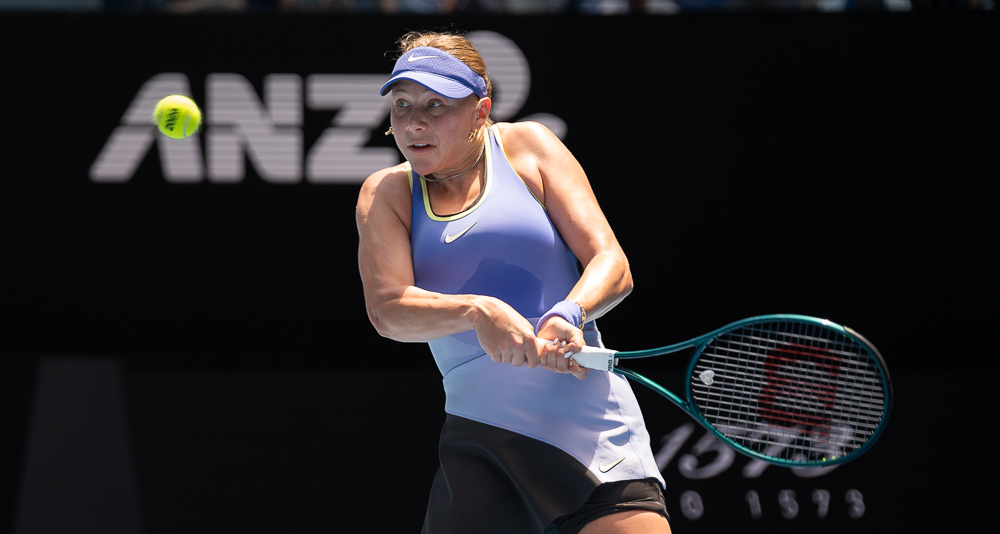
Amanda Anisimova’s career has been a story of early promise, a step away, and a powerful return. A French Open semifinalist at 17 in 2019, the American later took an extended break from the sport before rebuilding into one of its most dangerous ball-strikers. In 2025 she reached two Grand Slam finals — Wimbledon and the US Open — and climbed to a career-high World No. 3 in January 2026.
The breakthrough hasn’t yet produced a major title, and 2026 has been disrupted by a wrist injury. But the trajectory is clear: when healthy, Anisimova’s flat, early-strike power belongs in the conversation at every Slam. The profile is a two-time finalist still chasing the title her game suggests is coming.
Quick facts
- Full name: Amanda Kay Victoria Anisimova
- Nationality: United States (born Freehold Township, New Jersey; raised in Florida)
- Born: August 31, 2001
- Height: 5 ft 11 in (1.80 m)
- Turned pro: 2016
- Plays: Right-handed, two-handed backhand
- Coach: Sebastian Sachs
- Identity: Flat, early-strike power baseliner with one of the cleanest backhands on tour
Season snapshot — June 2026
- Current standing: Ranked World No. 6 (verify against the live WTA list before publishing); career-high was No. 3, reached in January 2026
- 2026 Grand Slams: Australian Open quarterfinal; third-round loss at Roland Garros to home favorite Diane Parry, in her first event back from a wrist injury
- Injury context: Sidelined by a wrist problem from the Miami Open in March; withdrew from the Italian Open before returning in Paris
- Race position: 15th in the live Race to the WTA Finals as of early June, outside the qualifying places
- Career titles: 4 WTA singles titles, including two WTA 1000 events (Doha and Beijing, 2025)
Snapshot data is time-sensitive and scheduled for quarterly review.
Snapshot
Anisimova hits flatter and earlier than almost anyone on tour, taking time away from opponents off both wings. Her backhand down the line is among the cleanest shots in the women’s game. The trade-off is the variance that comes with redline aggression — and, in 2025, the mental and physical resilience to turn a chastening Wimbledon final into a second straight Slam final weeks later.
Playing style and strengths
Flat power off both wings. She strikes early and close to the baseline, rushing opponents and shortening points.
Backhand down the line. A signature, high-quality shot she can hit for winners from defensive positions.
Resilience. The path from a 6–0, 6–0 Wimbledon final loss to a US Open final in the same season showed real competitive character.
Pressure points and vulnerabilities
- Variance: the aggression that wins matches can also produce error-strewn losses
- Health: the 2026 wrist injury interrupted her momentum and clay preparation
- Movement and defense relative to the tour’s best retrievers
- Converting major finals into a first Grand Slam title
Career milestones
- 2019: French Open semifinal at 17
- 2025: Two Grand Slam finals (Wimbledon, runner-up to Świątek; US Open, runner-up to Sabalenka) and first two WTA 1000 titles at Doha and Beijing
- 2026: Career-high ranking of World No. 3
- Career: Climbed from outside the top 200 to the top three inside two years
Grand Slam record in context
Anisimova’s major story has two arcs: a teenage semifinal at Roland Garros, then, after rebuilding, two finals in a single 2025 season. The 2026 Australian Open quarterfinal and an injury-affected Paris third round keep her firmly in the contender bracket. With grass and hard courts ahead — the surfaces of her two finals — the title drought is the headline she is positioned to end.
What to watch next
- Wrist and fitness — whether she returns to full health through the grass season
- First major title — converting finalist runs into a breakthrough at Wimbledon or the US Open
- Race recovery — climbing back toward WTA Finals qualification in the season’s second half