

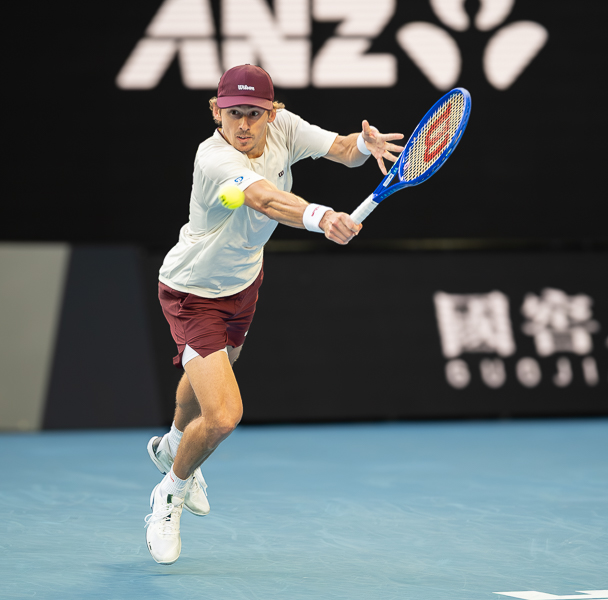
Alex de Minaur is Australia’s No. 1 and one of the most consistent presences in the men’s top 10, built on elite speed, defense and a relentless competitive work rate. The Sydneysider has won 11 ATP titles, reached the quarterfinals at all four majors and, in July 2026, climbed to a career high of world No. 5.
The defining storyline is still a stubborn ceiling. De Minaur is 0-7 in Grand Slam quarterfinals, and 2026 did not change that: a Melbourne quarterfinal loss to Carlos Alcaraz, then a third-round exit at Roland Garros, a fourth-round loss at Wimbledon and a second-round defeat at the US Open. The profile is a top-10 mainstay who wins titles, as he did in Rotterdam in February, but whose next frontier is converting consistency into a deep major run.
Quick facts
- Full name: Alex de Minaur
- Nationality: Australia (born Sydney; Spanish heritage)
- Born: February 17, 1999
- Height: 6 ft 0 in (1.83 m)
- Turned pro: 2015
- Plays: Right-handed, two-handed backhand
- Coach: Adolfo Gutiérrez
- Career high: World No. 5 (July 13, 2026)
- Identity: Lightning-quick counterpuncher with elite defense and fitness
Game overview
De Minaur wins with speed, defense and intensity rather than raw power. Among the quickest players on tour, he turns defense into offense, returns relentlessly and rarely gives away free points. The trade-off, and the reason for the quarterfinal ceiling, is a relative lack of a knockout weapon against the very best, reflected in a long winless record against Jannik Sinner.
Playing style and strengths
Speed and movement. Elite court coverage that frustrates bigger hitters and extends rallies.
Return and consistency. A strong return and low error count that grind opponents down.
Fitness and intensity. Among the fittest on tour, dangerous in long matches and best-of-five.
Pressure points and vulnerabilities
- A lack of overwhelming firepower against the very top of the game
- The Grand Slam quarterfinal barrier, 0-7, that defines his major story
- Holding a lead: at Roland Garros in 2026 he won the first set 6-0 and lost the next three
- Generating cheap points on serve against elite returners
Career milestones
- Quarterfinals at all four Grand Slams: Australian Open, Roland Garros, Wimbledon and US Open
- 2024: Roland Garros quarterfinal, his first beyond the second round in Paris
- 2025: ATP Finals semifinalist
- 2026: Rotterdam title, his 11th, after losing the final there in each of the two previous years
- 2026: Career-high ranking of world No. 5 on July 13
Grand Slam record in context
De Minaur’s major record is a study in consistency without breakthrough: quarterfinals at every Slam, but 0-7 at that stage and no semifinal yet. The 2026 majors made the gap plainer. After the Melbourne quarterfinal against Alcaraz, the eighth seed won the first set 6-0 against Jakub Mensik in the Roland Garros third round and lost 0-6, 6-2, 6-2, 6-3. “Pretty disappointing, missed opportunity,” he said, as reported by Tennis Australia.
Grass brought him to the second week at Wimbledon for a third straight year, but Flavio Cobolli beat him in straight sets in the fourth round, winning the second and third sets from a break down, according to the ATP Tour. In New York, seeded sixth, he lost in the second round to Botic van de Zandschulp, 6-4, 7-5, 6-2, the Dutchman’s first win over him in five meetings, ABC reported. He had reached the quarterfinals in New York in each of the two previous years.
Grand Slam best results
- Australian Open: Quarterfinal (2025, 2026)
- Roland Garros: Quarterfinal (2024)
- Wimbledon: Quarterfinal (2024)
- US Open: Quarterfinal (2020, 2024, 2025)
What to watch next
- Turin: whether the autumn swing carries him back to the Nitto ATP Finals, where he reached the semifinals in 2025.
- The first semifinal: whether he can finally break the quarterfinal barrier, starting in Melbourne in January.
- Added offense: developing more firepower while keeping his trademark defense.
Related reading
- Felix Auger-Aliassime Profile
- Flavio Cobolli Profile
- Jakub Mensik Profile
- Grand Slams Explained
- ATP Masters 1000 Guide
- ATP Finals and WTA Finals Guide
Season Snapshot — September 25, 2026
- Ranking: No. 9 on his ATP Tour profile; career high No. 5 (July 13, 2026); Australian No. 1
- 2026 title: Rotterdam (d. Felix Auger-Aliassime in the final)
- 2026 Grand Slams: Australian Open quarterfinal (l. Alcaraz); Roland Garros third round as 8th seed (l. Mensik 0-6, 6-2, 6-2, 6-3); Wimbledon fourth round as 5th seed (l. Cobolli); US Open second round as 6th seed (l. van de Zandschulp 6-4, 7-5, 6-2)
- Other 2026 results: Hamburg semifinal; Cincinnati fourth round (l. Arthur Fils 6-3, 6-4)
- Laver Cup: Beat Alexander Zverev 2-6, 7-6(5), 11-9 on Day 2 in London, keeping his Laver Cup singles record unbeaten, according to the Laver Cup; lost the final-day doubles with Taylor Fritz to Flavio Cobolli and Jakub Mensik 7-5, 6-3 as Team Europe won 13-5
- Coach: Adolfo Gutiérrez
This snapshot is dated and will change. The career record above does not.