

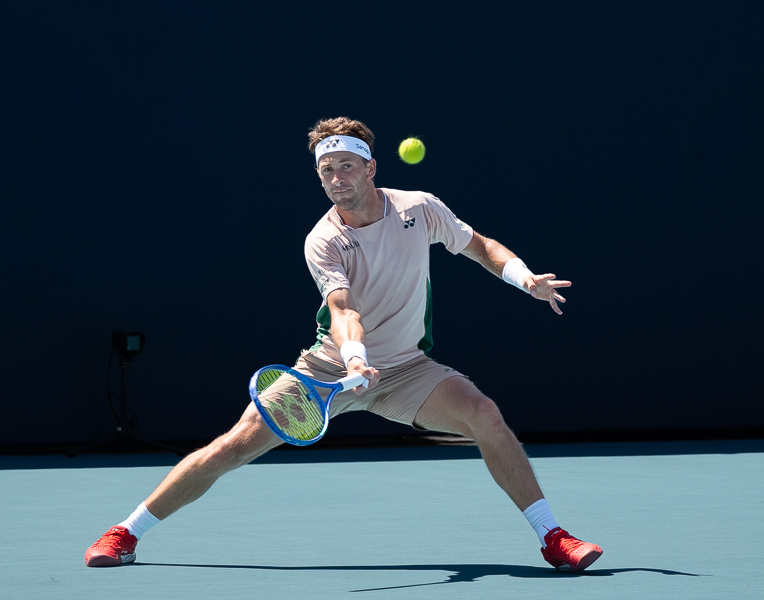
Casper Ruud is one of the most reliable clay-court players of his generation and, after a dip, is firmly back among the contenders. The Norwegian reached three Grand Slam finals between 2022 and 2023, broke through for a maiden Masters 1000 title in Madrid in 2025, and reaffirmed his level in 2026 with a run to the Rome final — completing the set of finals at all four of the sport’s biggest clay events.
What still eludes him is a major title. Ruud lost the 2022 and 2023 French Open finals and the 2022 US Open final, and remains in pursuit of the breakthrough his clay pedigree suggests is possible. The profile is a top-tier clay competitor and three-time major finalist chasing the last step.
Quick facts
- Full name: Casper Ruud
- Nationality: Norway (born Oslo)
- Born: December 22, 1998
- Height: 6 ft 0 in (1.83 m)
- Turned pro: 2015
- Plays: Right-handed, two-handed backhand
- Coach: Christian Ruud (his father) and Pedro Clar
- Identity: Heavy-topspin clay-court specialist with elite consistency
Season snapshot — June 2026
- Current standing: Around World No. 17 (verify against the live ATP list before publishing; the rankings update on June 8)
- Headline 2026 result: Reached the Rome Masters 1000 final (lost to Jannik Sinner), completing finals at all four major clay events — Roland Garros, Monte Carlo, Madrid and Rome
- Career-high: World No. 2, reached September 12, 2022
- Career titles: 14, including the 2025 Madrid Open, the first Masters 1000 title by a Norwegian
- Career majors: None yet — three finals (French Open 2022 and 2023, US Open 2022)
Snapshot data is time-sensitive and scheduled for quarterly review.
Snapshot
Ruud plays a classic modern clay game: heavy topspin off the forehand, disciplined consistency, and the patience to build points on slow surfaces. Long seen as a clay specialist, he has broadened his game enough to make a US Open final and reach the ATP Finals championship match, but red dirt remains where he is most dangerous.
Playing style and strengths
Topspin forehand. A heavy, reliable weapon that kicks up off clay and pushes opponents back.
Consistency. Low error counts and disciplined construction make him difficult to beat over best-of-five on clay.
Professional temperament. Steady, well-prepared and durable, qualities recognized with a sportsmanship award.
Pressure points and vulnerabilities
- Faster surfaces, where his game loses some of its margin — a modest grass record being the clearest example
- Beating the very best in finals, having lost his three major championship matches
- Generating cheap points against bigger servers and flatter hitters
- Sustaining his ranking against a deepening field
Career milestones
- 2022: French Open and US Open finals; ATP Finals runner-up; career-high World No. 2
- 2023: A second French Open final
- 2025: Maiden Masters 1000 title in Madrid, a first for Norway
- 2026: Rome final, completing the set of finals at the four biggest clay events
Grand Slam record in context
Ruud’s major record is anchored on clay: two French Open finals, plus a hard-court breakthrough at the 2022 US Open. The pattern is a player who reaches the final stages on his best surface but has yet to land the title. With the depth at the top of the men’s game, Roland Garros remains his most realistic route to a maiden major.
What to watch next
- A first major — whether his clay pedigree finally yields a Grand Slam title
- Ranking — building on the Rome run to climb back toward the top 10
- Surface range — translating clay results onto hard courts more consistently
Related reading
- Tennis Rankings Explained
- Grand Slams Explained
- ATP Masters 1000 Guide
- ATP Finals and WTA Finals Guide