
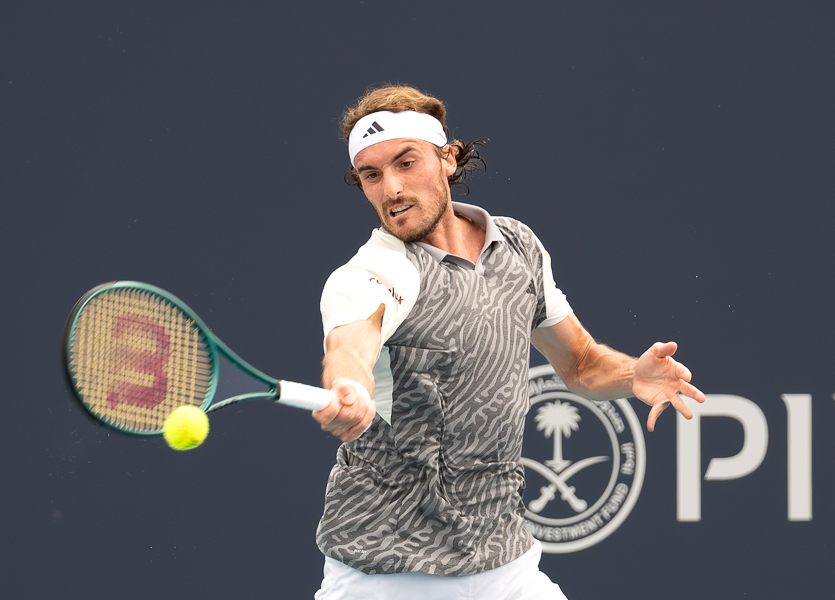
Stefanos Tsitsipas reached the top of the men’s game at his peak — a career-high World No. 3, an ATP Finals title, and two Grand Slam finals — before a steep decline driven by a recurring back injury and a loss of form pushed him out of the top 50. He began the 2026 US Open unseeded for the first time in his career there.
New York then produced his best week in a long time. In the first round he came back from a set and a break down to beat the 10th seed, Arthur Fils, who had won the Cincinnati Masters eight days earlier and had beaten Tsitsipas in all five of their previous meetings. He went on to reach the fourth round at the US Open for the first time, beating Jiri Lehecka in the third round. The profile is a former elite and two-time major finalist showing the first real signs of rediscovering the level that made him one of the most distinctive players of his generation.
Quick facts
- Full name: Stefanos Tsitsipas
- Nationality: Greece (born Athens; based in Monte Carlo)
- Born: August 12, 1998
- Height: 6 ft 4 in (1.93 m)
- Turned pro: 2016
- Plays: Right-handed, one-handed backhand
- Career-high ranking: World No. 3 (August 2021)
- Career majors: None — finalist at the 2021 French Open and the 2023 Australian Open; ATP Finals champion (2019)
- Identity: One-handed-backhand stylist with a heavy forehand, at his best on clay
Season snapshot — September 25, 2026
- US Open: Fourth round, his first at Flushing Meadows, as an unseeded player; beat 10th seed Arthur Fils 4-6, 7-6(3), 6-1, 6-4 in the first round, hitting 50 winners, and Jiri Lehecka in the third
- The Fils win: His first against the Frenchman after five straight defeats
- The slide: Fell from the top 10 in 2025 and out of the top 50 in 2026, hampered by a recurring lower-back injury
This snapshot is dated and will change. The career record elsewhere on this page does not.
Game overview
Tsitsipas plays an aggressive, one-handed-backhand game built around a heavy forehand and forward movement, historically most dangerous on clay. At his peak he combined that firepower with the athleticism to reach two major finals. The decline has been tied to back trouble and a dip in confidence rather than any single change in style, and his 50 winners against Fils showed the firepower is still there when he is healthy.
Playing style and strengths
Forehand. A heavy, aggressive weapon that anchors his offense.
One-handed backhand. A classic, admired shot, effective on clay though exposed by the biggest hitters.
Big-stage pedigree. Two major finals and an ATP Finals title.
Pressure points and vulnerabilities
- Health: a recurring lower-back injury has disrupted his recent seasons
- The backhand wing under heavy, high pace from the top players
- Turning one strong week into consistent results
- Rebuilding a ranking and seedings from outside the top 50
Career milestones
- 2019: ATP Finals champion at 21
- 2021: French Open final and career-high World No. 3
- 2023: Australian Open final
- 2026: First US Open fourth round, as an unseeded player
Grand Slam record in context
Tsitsipas’s major record features two finals — both lost to Novak Djokovic, at the 2021 French Open (from two sets up) and the 2023 Australian Open — plus multiple deep clay-court runs. His 2026 US Open fourth round, at a major where he had never previously reached the second week, is the clearest sign yet that the recovery is real. Roland Garros, given his clay pedigree, remains his most natural route back to the latter stages of the majors.
What to watch next
- Health — whether the back holds up through the autumn
- Ranking — climbing back toward seeded status at the majors after New York
- Clay in 2027 — the surface most likely to extend a recovery
Related reading
- Tsitsipas vs Lehecka: US Open 2026 Third Round
- Jiri Lehecka Profile
- Novak Djokovic Profile
- Grand Slams Explained