

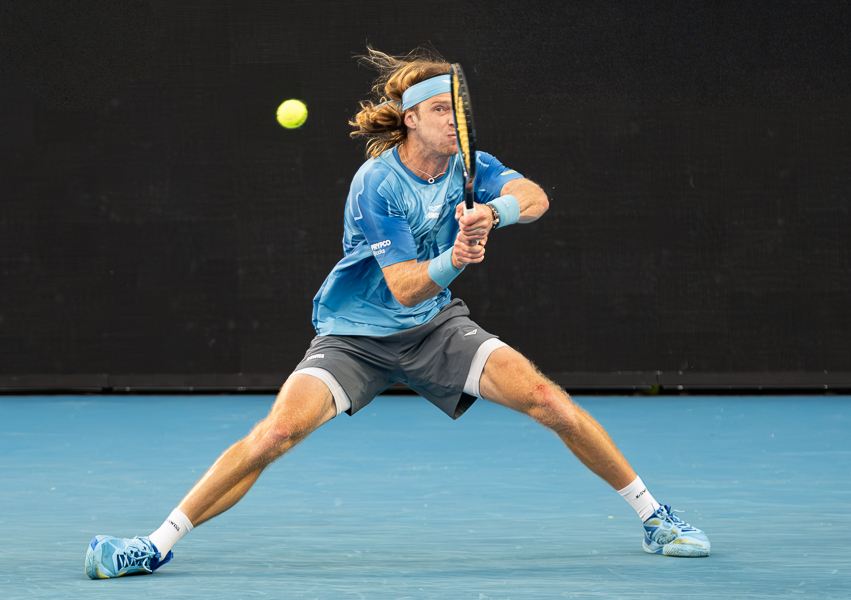
Andrey Rublev is one of the most consistent presences in the men’s game and the owner of one of its most striking statistics: he has reached the quarterfinals of all four Grand Slams, ten times in all, without ever reaching a semifinal. That 0-10 record at the last-eight stage defines a career that has otherwise featured a career high of world No. 5, 18 titles and two Masters 1000 crowns.
His 2026 has been a season of swings. He lost the Barcelona final to Arthur Fils, fought back from two sets down against Jakub Menšík in the Roland Garros fourth round before losing the fifth, and then ended a 17-month title drought in Bastad in July. “To be able to win here for a second time is a special feeling,” he said, according to the ATP Tour. Six weeks later he lost in the second round of the US Open to Daniel Mérida.
Quick facts
- Full name: Andrey Rublev
- Nationality: Russia (currently competes as a neutral athlete; based in Dubai)
- Born: October 20, 1997
- Height: 6 ft 2 in (1.88 m)
- Turned pro: 2014
- Plays: Right-handed, two-handed backhand
- Coach: Marat Safin (since April 2025) and Fernando Vicente
- Career titles: 18, including Masters 1000 crowns at Monte Carlo (2023) and Madrid (2024)
- Identity: Heavy-hitting power baseliner with intense competitive fire
Game overview
Rublev plays high-intensity, high-risk tennis built on a heavy flat forehand and relentless aggression. The power and work rate made him a near-permanent top-15 player and a two-time Masters champion. The same all-out approach, and the emotional volatility that sometimes comes with it, has been part of the story behind his repeated stumbles at the quarterfinal stage of majors.
Playing style and strengths
Forehand. One of the heaviest in the game, the engine of his offense.
Intensity and work rate. Relentless effort that overwhelms opponents on his best days, and a capacity to drag matches back from losing positions, as he did against Menšík in Paris.
All-surface results. Quarterfinals at every major and titles on hard and clay.
Pressure points and vulnerabilities
- The Grand Slam quarterfinal barrier, 0-10, that defines his major record
- Emotional control, with on-court frustration that can derail him in tight matches
- Finals: in Barcelona he broke Fils to lead 6-5 in the second set, then lost the tiebreak as Fils closed out the match with seven straight points, according to the ATP Tour
- A ranking that has slid from the top 15 to the mid-20s during 2026
Career milestones
- 2017: First Grand Slam quarterfinal, at the US Open
- 2020: A breakout season with five ATP titles
- 2021: Career-high world No. 5; Olympic mixed-doubles gold; Davis Cup title
- 2023: Maiden Masters 1000 title at Monte Carlo; quarterfinals at all four majors completed at Wimbledon
- 2024: Second Masters 1000 title in Madrid
- 2026: Second Bastad title, his 18th overall
Grand Slam record in context
Rublev’s major record is the purest example of consistency without breakthrough: ten quarterfinals across all four Slams, and not a single semifinal. In 2026 he did not reach another. Francisco Cerundolo beat him 6-3, 7-6(4), 6-3 in the Melbourne third round.
Paris came closest. As the 11th seed he lost the first two sets to Menšík on Court Suzanne-Lenglen, took the third 6-4 and the fourth 6-2 late into the night, and was beaten 6-3 in the fifth after three hours and 45 minutes. In New York, seeded 23rd, he won the first set against Mérida in a tiebreak and lost the next three, the ATP Tour reported.
Grand Slam best results
- Australian Open: Quarterfinal (2021, 2023, 2024)
- Roland Garros: Quarterfinal (2020, 2022)
- Wimbledon: Quarterfinal (2023)
- US Open: Quarterfinal (2017, 2020, 2022, 2023)
What to watch next
- Ranking: whether the autumn swing lifts him back toward seeding territory for Melbourne.
- The first semifinal: whether he can finally clear the quarterfinal hurdle at a major.
- Temperament: channeling his intensity in the decisive moments.
Related reading
- Jakub Mensik Profile
- Arthur Fils Profile
- Francisco Cerundolo Profile
- Grand Slams Explained
- ATP Masters 1000 Guide
Season Snapshot — September 25, 2026
- Ranking: No. 24 during the US Open, according to the ATP Tour; career high No. 5 (September 13, 2021)
- 2026 title: Bastad (d. Luciano Darderi 6-4, 6-3), his first since Doha in February 2025
- 2026 finals: Barcelona (l. Arthur Fils); Hangzhou, as second seed (l. Daniil Medvedev 7-5, 6-4, according to the ATP Tour; Medvedev now leads their head-to-head 8-2)
- 2026 Grand Slams: Australian Open third round as 13th seed (l. Cerundolo 6-3, 7-6(4), 6-3); Roland Garros fourth round as 11th seed (l. Menšík 6-3, 7-6(6), 4-6, 2-6, 6-3); US Open second round as 23rd seed (l. Mérida 6-7(3), 6-2, 6-4, 6-4)
- Mixed doubles: US Open semifinal with Mirra Andreeva
- Coach: Marat Safin and Fernando Vicente
This snapshot is dated and will change. The career record above does not.