

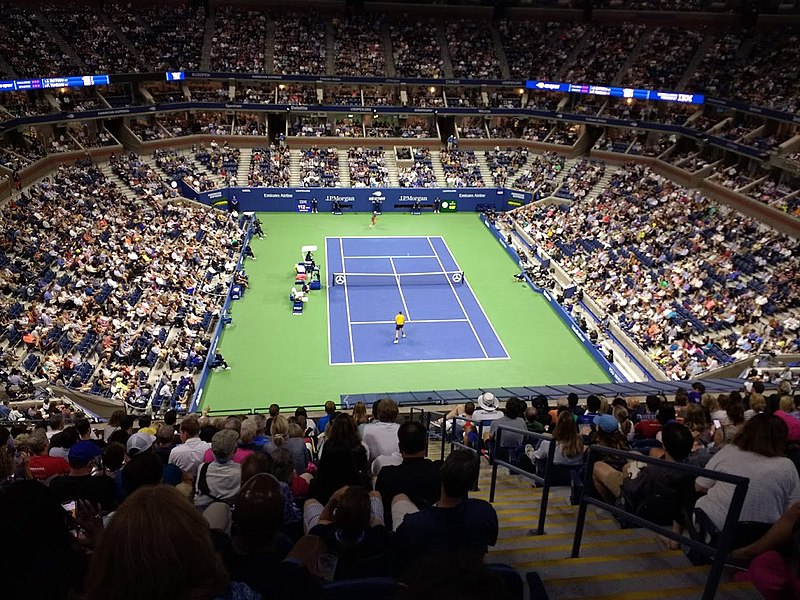
Arthur Ashe Stadium is the largest tennis arena in the world, the centerpiece of the biggest Grand Slam tournament on earth, and a venue named after one of the most consequential figures in the history of American sport. Understanding why it matters requires knowing both the building and the man it honors — because the two stories are inseparable.
Who Arthur Ashe Was
Arthur Robert Ashe Jr. was born on July 10, 1943, in Richmond, Virginia — a city where segregation governed daily life. His mother died when he was six years old, and he was raised by his father, a parks caretaker whose job gave the young Ashe access to the tennis courts at Brook Field Park in North Richmond. It was there, on courts he would otherwise have been barred from using, that he first picked up a racket.
Jim Crow restrictions barred Ashe from competing in most elite junior tournaments reserved for white players throughout his adolescence. He graduated as valedictorian of his high school class, earned a full scholarship to UCLA, and in 1963 became the first African American selected for the U.S. Davis Cup team. He graduated with a business degree in 1966 and served two years as a commissioned officer in the U.S. Army while continuing to compete.
On August 29, 1968, on the grass of the West Side Tennis Club at Forest Hills, Ashe defeated Tom Okker in the final of the inaugural US Open to become the first African American man to win a Grand Slam singles title. He was still an amateur — which meant he couldn’t accept the prize money — and he was seeded fifth, behind four Australians.
He went on to win the Australian Open in 1970 and Wimbledon in 1975, defeating Jimmy Connors in the final of the latter in one of the most tactically remarkable upsets in Grand Slam history. He remains the only Black man ever to have won the singles title at the US Open, the Australian Open, and Wimbledon.
Heart disease forced his retirement in 1980. During bypass surgery in 1983, a blood transfusion left him HIV-positive — a diagnosis he kept private until 1992, when a journalist was about to break the story and Ashe chose to make the announcement himself.
In the final year of his life, he became one of the world’s most prominent AIDS activists, founding the Arthur Ashe Foundation for the Defeat of AIDS and addressing the World Health Organization on World AIDS Day in December 1992. Sports Illustrated named him Sportsman of the Year in 1992. He died on February 6, 1993, at the age of 49.
Beyond tennis, Ashe helped found the Association of Tennis Professionals (ATP) in 1972 — the organization that unionized the professional tour. He co-founded the National Junior Tennis League to provide tennis access to underserved youth. He was arrested outside the South African Embassy in Washington D.C. in 1985 protesting apartheid, and arrested again at the White House in 1992 advocating for Haitian refugees.
He wrote eight books, contributed to The Washington Post and Time magazine, and spent much of his post-playing career dismantling the barriers that had constrained him as a child. He was, as historian Ray Arsenault wrote, “the Jackie Robinson of men’s tennis.”
The Idea That Became a Stadium
The stadium that bears his name was not planned from the beginning of the USTA’s tenure at Flushing Meadows. When the National Tennis Center opened in 1978, its center court was Louis Armstrong Stadium — a renovated version of the old Singer Bowl, a 1960s concert arena that had hosted Jimi Hendrix and Janis Joplin before being converted into a tennis facility.
The idea for a new, purpose-built centre court came in January 1977, when USTA president William Hester spotted the underused Singer Bowl on a flight approach into LaGuardia Airport and arranged with the City of New York to use the site for tennis.
The National Tennis Center opened in 1978, but it became clear through the following decade that the tournament had outgrown its centerpiece. Armstrong Stadium, with a capacity of around 20,000, was expanded and modified repeatedly — but as the US Open grew in commercial scale and global profile, those fixes were no longer sufficient.
In 1993 — the year Ashe died — the USTA broke ground on a new main stadium. The project cost $254 million and was designed by Detroit-based firm ROSSETTI, led by architect Gino Rossetti.
The stadium opened in August 1997 as the world’s largest dedicated tennis venue, with a seating capacity of over 23,000, including 90 luxury suites, five restaurants, and a two-level players’ lounge.
It was named Arthur Ashe Stadium at its opening — a decision made four years after Ashe’s death, in recognition of a man whose victories had been played on grass courts a mile away at Forest Hills, and whose legacy had shaped the sport’s relationship with American society for a generation.
The Scale of the Building
Arthur Ashe Stadium holds 23,771 spectators — more than any other tennis stadium in the world, by a significant margin. The next largest Grand Slam main courts — Court Philippe-Chatrier at Roland Garros, Centre Court at Wimbledon, and Rod Laver Arena in Melbourne — each hold approximately 15,000. Ashe is larger than all three combined would be if you subtracted one.
The stadium is octagonal in plan and rises steeply, its upper tiers pushing spectators far above the court level. The court surface sits well below street level, which contributes to the sense of enclosure even in the open-air configuration.
When full for a night session match, with close to 24,000 people reacting simultaneously, the volume inside the bowl is unlike anything in tennis — and by many accounts unlike anything in any sport conducted in an arena of this type.
The facility features five restaurants, 90 luxury suites, and a two-level players’ lounge. Every year during the US Open’s two-week event, the National Tennis Center hosts over 750,000 people, including fans, sponsors, and athletes — making it the largest tennis event in the world.
The Retractable Roof: Engineering on an Extraordinary Scale
The original 1997 stadium was built without a roof. For nearly two decades, it was the only Grand Slam main court in the world without weather protection — and the consequences were felt acutely. Rain delays disrupted scheduling regularly, and five consecutive US Open men’s singles finals from 2008 to 2012 were affected by inclement weather. In 2010, the USTA initiated a master planning process to find a solution.
The challenge was formidable. The primary structural challenge was designing a retractable roof for a venue that was not structurally designed to carry any additional load, compounded by poor soils from the site’s history as a dump for New York City’s coal ash — which required foundations driven deep into the ground to reach bedrock.
The solution ROSSETTI designed — the same firm that had built the original stadium — is among the most technically ambitious structures in sport. The lightweight, octagonal roof measures 520 by 520 feet, covered with 190,000 square feet of Teflon-coated fiberglass membrane that blocks 90 percent of solar radiation while maintaining daylight transmission.
It is supported by eight steel columns, each sitting on concrete bases driven 175 to 200 feet into the ground. The 250-by-250-foot retractable opening — the largest of any tennis stadium in the world — can be opened or closed in under 10 minutes, with computers monitoring over four dozen sensors tracking movement, wind speeds, seismic activity, motor speed, and torque simultaneously.
The roof cost $150 million and was part of a broader $550 million renovation of the National Tennis Center. It was completed in time for the 2016 US Open. Its first use during a match came when rain fell during a night session — and the roof’s acoustic effect, trapping crowd noise inside the bowl rather than releasing it upward, immediately changed the atmosphere of the stadium in ways players noticed from the first point.
The Ongoing Transformation
Arthur Ashe Stadium is not standing still. An $800 million renovation is currently planned by ROSSETTI — the firm’s third major project at the venue — including significant renovations to the stadium itself and the creation of a new Player Performance Center. All construction is expected to be completed by 2027.
The renovation will bring restaurants, retail, and expanded hospitality inside the stadium bowl itself for the first time, transforming the in-venue experience for spectators who previously had to exit the building to access food and shopping.
The broader National Tennis Center campus has also undergone continuous transformation. The 85 percent redesign completed between 2013 and 2018 rebuilt Louis Armstrong Stadium — now holding 14,053 seats with its own retractable roof — and added a new Grandstand court seating 8,125.
The result is a precinct with four roofed venues and 22 courts that has no direct equivalent in world tennis for sheer scale and infrastructure investment.
The Name Means Something
The decision to name the world’s largest tennis stadium after Arthur Ashe was not a commercial arrangement or a naming rights deal. It was a tribute — to a man who had grown up barred from the sport by segregation, reached its summit through extraordinary talent and determination, and then used his platform to fight for others for the rest of his life.
The stadium name has carried weight in the decades since. Arthur Ashe Kids’ Day, an annual free event held at the National Tennis Center since the stadium opened in 1997, celebrates Ashe’s commitment to youth development through tennis clinics, live performances, and educational activities.
Attendance reached a record 47,875 participants in 2024. Proceeds support the National Junior Tennis and Learning network — the program Ashe co-founded to provide tennis and life skills to underserved youth.
The ESPY Award for courage in sport — one of the most prestigious individual honours in American athletics — is called the Arthur Ashe Courage Award. Recipients have included Muhammad Ali, Nelson Mandela, Pat Tillman, Caitlyn Jenner, and Simone Biles.
The award carries Ashe’s name because, as the selection committee has consistently framed it, courage and the willingness to stand for something larger than sport were the defining qualities of his life.
The Moments That Defined the Stadium
In less than three decades, Arthur Ashe Stadium has accumulated a history of its own. The Williams sisters have dominated its night sessions across two eras of women’s tennis, with Serena Williams winning six US Open titles on its blue courts. Roger Federer, Rafael Nadal, and Novak Djokovic have contested some of their most celebrated matches here.
The 2001 women’s final — Venus against Serena, the first Grand Slam final between two sisters — was moved to a prime-time Saturday night slot in recognition of its cultural significance, changing the television landscape for women’s tennis permanently.
Serena Williams’s farewell at the 2022 US Open brought a crowd that included Oprah Winfrey, Bill Clinton, Hugh Jackman, and Spike Lee to a first-round match — a level of celebrity attention that reflected the intersection of sport, culture, and history that the stadium has come to represent. Billie Jean King came onto the court afterwards. The crowd didn’t want it to end.
The stadium has hosted events well beyond tennis. It served as a venue for the 2019 Fortnite World Cup, with a $30 million prize pool. It has hosted professional basketball and professional wrestling. The Westminster Kennel Club Dog Show used it in 2023 and 2024 while displaced from Madison Square Garden. Its scale and infrastructure have made it one of the most versatile large-format venues in New York City.
The Bottom Line
Arthur Ashe Stadium matters for reasons that extend well beyond its capacity figures and roof engineering. It is the largest tennis arena in the world, built to contain a tournament that has become the sport’s biggest annual event.
It is a venue that has been continuously invested in, rebuilt, and expanded to remain at the frontier of what a sports facility can be. And it carries the name of a man who grew up barred from tennis courts by the color of his skin, became the first Black man to win three different Grand Slams, and spent the rest of his life making the world more fair.
The stadium’s scale is impressive. The name above the entrance is the reason it matters.