

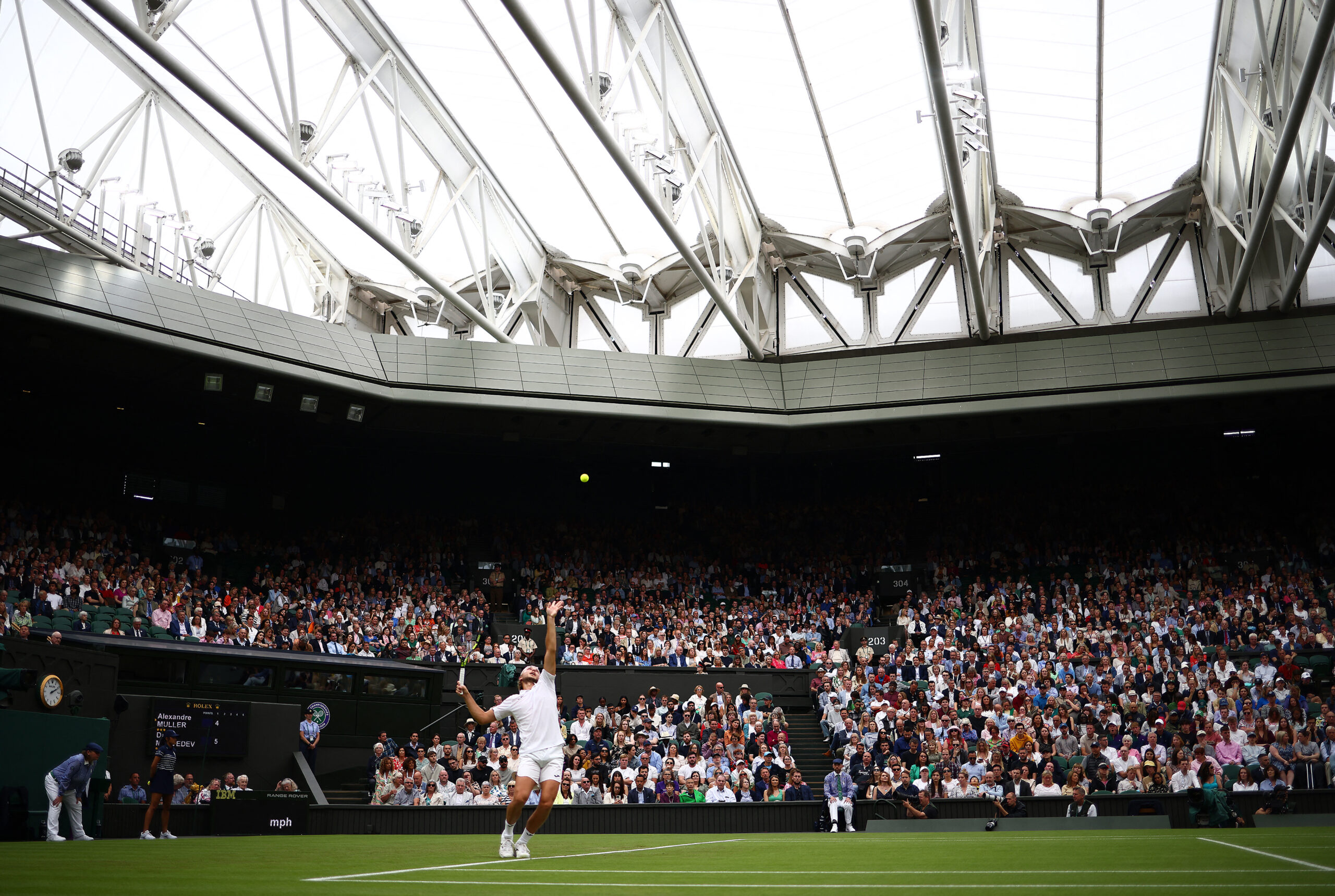
Centre Court at Wimbledon is widely regarded as the most famous tennis court in the world. It has hosted every Wimbledon singles final since 1922, survived a World War II bombing, been rebuilt in stages across a century, and accumulated a weight of history that no other tennis venue can approach. Here is the complete story of how it came to be, how it changed, and why it still matters.
Why It Is Called Centre Court
The name has a literal origin that most people never know. At the All England Croquet Club’s original site on Worple Road in Wimbledon, the courts were laid out in a 3×4 grid of 12 courts. In 1877, the first Wimbledon Championship was held across those 12 courts — there was no actual “Centre Court.”
In 1881, the two middle courts of the middle row were combined to form a single, larger principal court. Because it sat at the center of all the other courts, it was called Centre Court.
When the club relocated to Church Road in 1922, the name travelled with it — even though the new Centre Court was not, at first, geographically central to the other courts at the new site.
It was not until a further four courts were added in 1980 that Centre Court’s location in the grounds again matched its name. The name had outlasted its original meaning by nearly 60 years before reality caught up with it.
From Worple Road to Church Road: The 1922 Move
By the end of the First World War, tennis had grown far beyond what the Worple Road site could accommodate. Public appetite for the sport had expanded dramatically, crowds were exceeding the venue’s capacity, and the All England Club needed a larger, purpose-built home. In 1920, two plots of land at Church Road were purchased for £7,870. Construction began immediately.
It took 3,000 tons of shingle, 1,700 tons of sand, 600 tons of cement — and just nine months — for the court to be created. The all-important turf was imported from Cumberland. The new Centre Court opened on 26 June 1922, with an initial capacity of around 13,000 — combining 9,989 seats with approximately 3,600 standing positions.
The design by architect Captain Stanley Peach reflected the character of its era: reserved, intimate, structured, and unmistakably British. Wooden bench seating, an open-air bowl, and a partial roof over the stands that shielded some spectators from rain while leaving the court itself fully exposed to the English summer sky.
The inaugural final on the new Centre Court was the 1922 men’s singles, watched by a crowd that included members of the royal family for the first time — a relationship between the court and the Crown that has never since been interrupted.
The first women’s singles final on the court that year was watched by King George V and Queen Mary. Suzanne Lenglen won it, as she won everything at Wimbledon during that era, without losing a set.
A Bomb, Repairs, and Decades of Evolution
Centre Court survived the second World War — but only just. During World War II, Centre Court was damaged by five 500lb bombs in an air attack in 1940. A total of 1,200 seats were destroyed in the stadium, but the court wasn’t fully repaired until 1949 despite play still occurring in the years between.
The Championships were suspended entirely from 1940 to 1945, and the grounds served as a farm and as an ARP headquarters during the war years. That the fabric of the building survived at all — let alone that it was restored and returned to competitive use — reflects the practical resilience that has characterized the All England Club throughout its history.
Post-war, the changes came steadily. The famous Clubhouse balcony was added in 1955. The East Building was constructed in 1967, followed by the North Building in 1975. Each addition increased capacity modestly while attempting to preserve the intimate character of the original bowl.
In 1979, the original roof was raised by one meter to allow the capacity to be increased by 1,088. Further building work came in 1992 with a replacement of the roof and a modified structure which allowed 3,601 seats to have a clearer view of the court which had previously been restricted by the number of roof supports.
The Retractable Roof: An Engineering Solution to a Century-Old Problem
Rain has been disrupting play at Centre Court since 1877 — the very first Wimbledon final was postponed by rain. For most of the court’s history, this was simply accepted as part of the English summer experience. Players waited. Spectators sheltered. Play resumed when the weather allowed.
The tradition of the Wimbledon rain delay became so embedded in British culture that it generated its own rituals, including the famous occasions when Cliff Richard has spontaneously performed for restless crowds on Centre Court while waiting for the weather to pass.
The decision to build a retractable roof came after years of debate and was catalyzed most dramatically by the 2008 men’s final between Roger Federer and Rafael Nadal — a match that lasted nearly seven hours partly due to rain delays, as the new roof had not yet been built, and which ended in near-darkness as officials debated whether to suspend play for the night. The match is widely regarded as one of the greatest in tennis history; it also made the case for the roof more powerfully than any administrative argument could.
The engineering challenge was formidable. The primary design requirement was that the roof must not block the natural light that sustains the grass — the most important thing to determine was how not to block the sunlight that feeds the world’s most visible patch of grass.
The result is a 65-by-75-meter hydraulically operated structure of translucent fabric supported by steel trusses. The translucent PTFE (polytetrafluoroethylene) fabric, supplied by W.L. Gore and Associates in Germany, transmits 40 percent of natural light — enough to maintain the grass in playable condition when the roof is closed.
The roof’s ten trusses each weigh 100 tonnes, and the total weight, including non-moving parts, is 3,000 tonnes. The total area of the roof when fully deployed is 5,200 m². Each truss moves along a track at 214 millimetres per second, driven by hydraulic jacks. The two sections of the roof meet in an overlapping seam above the middle of the court.
The roof takes up to 10 minutes to close, during which time play is suspended. However, the time to transfer from outside to inside play can be up to 45 minutes while the air-conditioning system acclimatizes the nearly 15,000-seat stadium for indoor grass competition.
The air-conditioning system is as critical as the roof itself. A closed Centre Court with 15,000 people generating body heat and breath moisture creates conditions that could, without intervention, produce condensation on the underside of the roof fabric or sweating of the grass surface — either of which would make the court slippery and unplayable.
The air management system maintains humidity and temperature within a narrow band that keeps both the grass and the playing conditions safe.
The retractable roof structure was ready for the 2009 Championships, being unveiled in April 2009 and tested with a capacity audience during an exhibition match on 17 May 2009, featuring Andre Agassi, Steffi Graf, Tim Henman, and Kim Clijsters.
The first competitive use came on 29 June 2009, during a fourth-round women’s singles match. The first full match played under the closed roof was between Andy Murray and Stanislas Wawrinka — a match that ended at 10:38pm, later than any Centre Court match in history to that point.
The Kipling Inscription
When the retractable roof was installed in 2009, the All England Club took the opportunity to make one addition to the players’ entrance corridor that had nothing to do with engineering. Etched into the wall of the archway through which players walk onto Centre Court are two lines from Rudyard Kipling’s 1910 poem If: “If you can meet with Triumph and Disaster / And treat those two impostors just the same.”
The inscription was placed at eye level, in a simple elegant font, so that every player entering Centre Court passes it in the moments before they step onto the most famous court in the world. The quote symbolizes the mental resilience required in professional tennis, aligning with Wimbledon’s emphasis on graceful conduct under pressure.
Whether it helps, or whether players notice it at all when the adrenaline of a Wimbledon match is already rising, is impossible to know. But its placement is deliberately intentional: the All England Club chose to remind every player, at the most consequential moment of their working day, that the outcome — whatever it is — should be received with equanimity.
The choice of Kipling is itself characteristically Wimbledon. If is one of the most recognizable poems in the English language, taught in British schools for generations, and its values — stoicism, self-control, perseverance, dignity in both victory and defeat — are precisely the values the All England Club has always believed Wimbledon should embody.
What Centre Court Has Witnessed
The history of Centre Court is, in a very real sense, the history of tennis. Every Wimbledon singles final since 1922 has been played on this court. The list of champions who have won on it spans the entire story of the sport’s development: Suzanne Lenglen, Helen Wills Moody, Fred Perry, Don Budge, Maureen Connolly, Rod Laver, Billie Jean King, Björn Borg, Martina Navratilova, John McEnroe, Steffi Graf, Pete Sampras, Serena Williams, Roger Federer, Rafael Nadal, and Novak Djokovic have all lifted the Wimbledon trophy here.
Martina Navratilova won nine Wimbledon singles titles on this court — more than any other player. Roger Federer won eight. Pete Sampras won seven. Serena Williams won seven. The combined weight of those records on a single court, across a century of competition, is without parallel in sport.
The court has also hosted moments that transcended tennis entirely. Billie Jean King’s victories here in the 1970s, delivered in the same years she was fighting for equal prize money and recognition for women’s tennis worldwide, gave Centre Court a cultural significance beyond sport.
Arthur Ashe’s 1975 victory — the first Black man to win Wimbledon singles — was achieved on this court, in front of a full house, in the same year he was publicly advocating for change in a sport whose traditions did not always welcome it.
The 2008 Federer-Nadal final — five sets, nearly five hours of tennis interrupted by two rain delays, played in fading light as officials debated calling it off for the day — is consistently voted among the greatest sporting events ever witnessed.
It was played on Centre Court without a roof, in conditions that were, by the end, barely adequate. The imperfection of those conditions is part of why the match is remembered the way it is.
Centre Court and the Olympics
Centre Court has twice hosted Olympic tennis. In 1908, the London Olympics included tennis at the original Worple Road site. More significantly, Centre Court, along with No. 1 Court and No. 2 Court, was host to the tennis competition at the 2012 Summer Olympics.
Andy Murray won gold at the London Games on Centre Court — defeating Roger Federer in the final on the same court where Federer had beaten him in the Wimbledon final just four weeks earlier.
Murray described winning in front of a home crowd on Centre Court as one of the most significant moments of his career, particularly in the context of his complicated relationship with Centre Court across the preceding years.
The Meaning of the Court
Centre Court means something beyond its function as a playing surface. It is the physical location where the sport’s longest continuous tradition has been enacted — where the same tournament has been held, on the same grass, by the same institution, for over a century. Other Grand Slam venues are larger, louder, more commercially powerful. None of them carries this particular weight.
The court’s meaning is inseparable from what it asks of the people who play on it. The Kipling inscription. The silence of 15,000 people between points. The knowledge that every player who has ever been great in this sport has stood on this exact rectangle of grass and been tested.
The combination of those things — the history, the expectation, the silence, and the luminous quality of the English summer light on the turf — produces an environment that players describe, more often than not, in terms that go beyond the technical vocabulary of tennis. They say it is different. They say you feel it before the first ball is struck. They say there is nothing else like it.
They are right.
The Bottom Line
Centre Court at Wimbledon is a building that has been bombed, rebuilt, incrementally expanded, given a roof after decades of delay, and etched with poetry. It has hosted 100-plus years of finals, an Olympic gold medal match, and some of the most significant moments in the history of professional sport. Its capacity is modest by the standards of modern arena design.
Its grass surface is maintained at 8 millimeters — a detail that requires year-round attention, specific seed varieties, and precise mowing schedules. Its name derives from a court layout that no longer exists. And it remains, by the consensus of players, officials, and observers across every era of the sport, the most important tennis court in the world.