

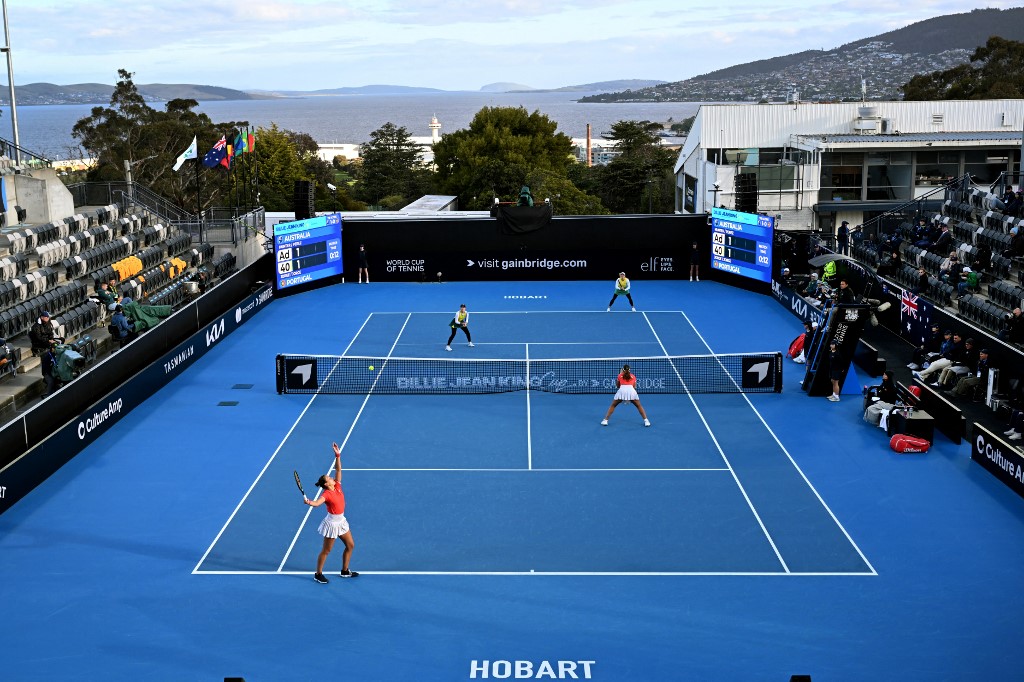
The Billie Jean King Cup, organized by the International Tennis Federation, stands as the premier international team competition in women’s tennis, drawing a record 148 nations in 2026 across its multi-tiered structure.
Formerly known as the Fed Cup until its 2020 renaming in honor of tennis pioneer Billie Jean King, the event features a pyramid of regional groups, play-offs, qualifiers and a culminating finals week, with promotion and relegation determining advancement. The format emphasizes home-and-away ties in early stages and a neutral-site knockout for the finals, aligning closely with the men’s Davis Cup.
Key elements include best-of-five-match ties in qualifiers and play-offs, guaranteed doubles rubbers starting in 2026, and round-robin pools in regional events. Nations compete for promotion to higher tiers, with the top eight battling for the title in September. Eligibility requires teams of three to five players, nominated by national associations based on rankings, with captains overseeing strategy.
The competition unfolds over the year, starting with regional groups in April, followed by qualifiers the same month, play-offs in November and finals in September. Regional groups span four levels (I to IV), divided by zones: Africa, Americas, Asia/Oceania and Europe (merged with Africa for Groups I and II).
These week-long events at single venues begin with round-robin pools, followed by play-offs for promotion and relegation; formats adjust based on entrant numbers, with ties typically best-of-three (two singles, one doubles). Winners from Group I advance to play-offs.
Play-offs, set for the week of Nov. 16, 2026, pit seven losers from April qualifiers against seven Group I winners in home-or-away ties. Hosts choose the surface, and ties span two days: two singles on day one, doubles first on day two, then two more singles. The first nation to three wins advances; all matches are best-of-three tiebreak sets. Winners move to the next year’s qualifiers, losers drop to regional Group I.
Qualifiers on April 10-11, 2026, involve 14 nations: seven non-host teams from the prior finals and seven play-off winners. Like play-offs, these are home-or-away ties with the same two-day, five-rubber structure, guaranteeing a live doubles match—a 2026 innovation. Seven winners qualify for finals; losers enter play-offs. The host nation for finals automatically qualifies.
The finals, from Sept. 22-27, 2026, in Shenzhen, China, feature eight teams in a straight knockout: quarterfinals, semifinals and final. Ties here are best-of-three: two singles followed by doubles, all best-of-three sets. The defending champion earns a home qualifier tie the following year.
While the cup promotes global participation, lower-tier events can vary in competitiveness, and top players’ availability depends on schedules. Nations rankings, based on recent results, influence seeding and draws.
Example: A Typical Qualifier Tie
In a 2026 qualifier between Nation A (host) and Nation B on hard court: Day 1 features A’s No. 2 vs. B’s No. 1, then A’s No. 1 vs. B’s No. 2. Day 2 starts with doubles, followed by reverse singles if needed. If A wins 3-0 by end of doubles, remaining singles are not played.
Formats evolve; the 2026 shift to guaranteed doubles and pairwise ties in qualifiers and play-offs replaced 2025’s group-of-three round robins, per ITF adjustments for engagement and alignment with Davis Cup. Team counts and venues can fluctuate annually based on entries and hosting bids.
The table illustrates the progression through the Billie Jean King Cup’s tiers as of the 2026 edition.
| Stage | Teams | Format | Key Outcome |
|---|---|---|---|
| Regional Groups (I-IV) | Varies by zone | Round-robin pools + play-offs at one venue | Promotion to play-offs (Group I winners); relegation to lower groups |
| Play-offs | 14 | 7 home-or-away ties over 2 days (2 singles Day 1; doubles + 2 singles Day 2) | Winners to qualifiers; losers to Group I |
| Qualifiers | 14 | 7 home-or-away ties over 2 days (same as play-offs) | Winners to finals; losers to play-offs |
| Finals | 8 | Knockout (QF, SF, Final) at neutral site; best-of-3 ties | Champion determined |
The structure ensures broad participation while funneling top teams to a high-stakes finals.