

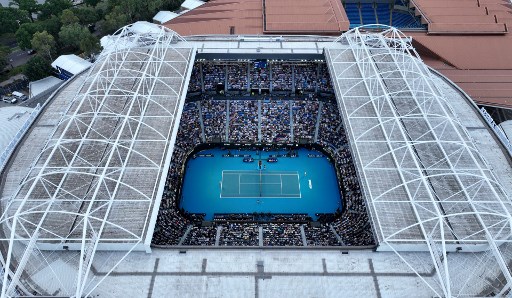
Melbourne Park has been home to the Australian Open since 1988, but the tournament’s journey to its current address is a story decades in the making — one involving overflowing crowds, a fading grass-court venue, a $94 million construction project, and a transformation that turned a distant fourth Grand Slam into one of the biggest sporting events in the Southern Hemisphere.
A Tournament That Never Stayed Still
For most of its early history, the Australian Open had no fixed home at all. First held in 1905 at the Warehouseman’s Cricket Ground in Melbourne — a venue now known as Albert Reserve — the tournament spent its first six decades bouncing between cities.
Melbourne, Sydney, Adelaide, Brisbane, and Perth all hosted at various points, and the tournament even travelled across the Tasman Sea on two occasions, to Christchurch in 1906 and Hastings in 1912.
The constant rotation made it difficult to build a loyal fan base or attract consistent top-level international players. Getting to Australia from Europe in the early 20th century involved a 45-day journey by ship, which discouraged many of the world’s best players from making the trip at all.
Even within Australia, the distances between cities meant many domestic players couldn’t easily travel to compete when the tournament was held interstate.
Kooyong: A Permanent Home at Last
The wandering era ended in 1972, when it was decided the Australian Open would settle permanently in Melbourne — the city that had consistently drawn the strongest crowds. The venue chosen was the Kooyong Lawn Tennis Club, a historic suburban club in the eastern Melbourne suburb of Kooyong whose iconic horseshoe-shaped grass stadium had opened in 1927.
The Kooyong era produced some of tennis’s most memorable moments. Rod Laver, Ken Rosewall, Evonne Goolagong, John McEnroe, Martina Navratilova, and Mats Wilander all competed there on the club’s grass courts. The 1972 tournament itself was won by Ken Rosewall, who at 37 years and 62 days remains the oldest Grand Slam singles champion in tennis history.
The tournament also went through a peculiar scheduling period during this era. The 1977 Australian Open was played twice — once in January and once in December — as organisers attempted to shift the calendar. The tournament then remained in December until 1985, before moving back to January, which meant the 1986 Australian Open was skipped entirely.
Why Kooyong Had to Go
By the early 1980s, it was becoming clear that Kooyong couldn’t keep pace with the tournament’s growth. The stadium held around 8,500 spectators — a fraction of what other Grand Slams could offer.
The grass courts required intensive maintenance and were vulnerable to Melbourne’s unpredictable summer weather. And the suburban club setting lacked the infrastructure needed to host a truly world-class event.
After the 1983 Australian Open, the International Tennis Federation formally urged the Lawn Tennis Association of Australia to find a new venue, citing Kooyong’s inadequacy for an event of this scale. Upgrade proposals for the club were explored but ultimately fell through.
The final tournament at Kooyong came in 1987. Perhaps sensing the end of an era, a record 140,000 fans attended that year’s event — the biggest crowd the old ground had ever seen. It was the last Australian Open played on grass.
Building Flinders Park: A $94 Million Gamble
In 1985, the Victorian Government identified a site on the edge of Melbourne’s central business district — Flinders Park, a former railyards precinct near the Yarra River — as the location for a new purpose-built National Tennis Centre. The project cost $94 million and was completed in two stages, with the first stage finished in 1987 in preparation for the 1988 tournament.
The new facility was unlike anything tennis had seen. Its centrepiece was a stadium court with a retractable roof — the first of its kind at any tennis venue in the world. The move also brought with it a new playing surface: Rebound Ace, a hard court material that replaced the grass courts of Kooyong and aligned the Australian Open with the US Open as a hard-court Grand Slam.
The reaction when the doors opened was immediate. The Age journalist Tim Colebatch wrote on January 12, 1988, that the National Tennis Centre was “a triumph,” describing spectators and players wandering through it “in a state of wonder at the scale, beauty and excellence of the facilities.” Chris Evert, a finalist that year, called it “pretty close” to the world’s best tennis complex.
1988: The Move Pays Off Immediately
The numbers told the story clearly. Compared with the 1987 tournament at Kooyong, the 1988 Australian Open at Flinders Park drew almost double the number of spectators — 266,436 in total, a 90 percent increase.
Stefan Edberg and Steffi Graf won the singles titles at the inaugural hard-court Australian Open. The tournament’s status, long considered a distant fourth among the four Grand Slams, began to rise.
Night tennis became a regular feature for the first time, enabled by the new facility’s lighting infrastructure. It was a change that would go on to define much of the Australian Open’s modern identity, producing some of the tournament’s most iconic late-night matches.
From Flinders Park to Melbourne Park
The venue continued to evolve through the 1990s. Ahead of the 1996 tournament, the second stage of the National Tennis Centre was completed, effectively doubling the size of the precinct. The expansion added a 3,000-seat Show Court 3 and Garden Square — a grassed public plaza with a giant screen where fans could watch the action outside the main stadiums.
It was also in 1996 that Flinders Park was officially renamed Melbourne Park by the Victorian Government. That same year marked another milestone: the Australian Open was finally granted ranking points equal to the other three Grand Slams, a recognition that the tournament had fully closed the prestige gap with Wimbledon, the French Open, and the US Open.
The Stadiums Get Their Names
The turn of the millennium brought further transformation. In 2000, a new multi-purpose 10,500-seat stadium opened at Melbourne Park, making the venue the first facility in the world to have two roofed tennis stadiums. That arena — now known as John Cain Arena — debuted for tennis at the 2001 Australian Open.
In 2000, the main Centre Court was renamed Rod Laver Arena, honoring the Australian legend who won 11 Grand Slam singles titles and remains the only player in the Open Era to complete two calendar-year Grand Slams.
Three years later, the Show Court 1 was renamed Margaret Court Arena, recognizing the Australian who holds the all-time record of 24 Grand Slam singles titles.
Changing the Surface (Twice)
The switch from grass to hard court in 1988 was just the first of several surface changes at Melbourne Park. Rebound Ace served as the tournament’s surface for 20 years, but by the mid-2000s, concerns about its heat retention — the dark green surface absorbed and radiated significant warmth in Melbourne’s summer conditions — led to calls for a change.
In 2008, Rebound Ace was replaced by Plexicushion Prestige, a blue cushioned acrylic surface that was lighter in color and offered a slightly different pace of play. Mats Wilander remains the only player in history to have won the Australian Open on both grass and hard courts, having triumphed at Kooyong in 1983 and at Flinders Park in 1988.
Then in 2020, Plexicushion was replaced by GreenSet, the surface currently in use. GreenSet is classified by the ITF as a Category 4 (Medium Fast) surface and plays noticeably faster than its predecessor.
The Modern Melbourne Park
The Melbourne Park of today looks almost nothing like the Flinders Park that opened in 1988. Decades of investment and expansion have transformed the precinct into one of the world’s premier sporting venues. A major redevelopment program that ran through the 2010s added new facilities, upgraded existing stadiums, and expanded the footprint of the precinct significantly.
The Tanderrum Bridge, opened in 2017, connected Melbourne Park to the city’s edge for the first time, integrating the venue into the broader urban fabric of Melbourne’s CBD. Food, entertainment, and festival infrastructure have grown to match the tournament’s ambition, with the Australian Open now positioning itself as much as an entertainment event as a sporting one.
The 2020 Australian Open injected A$387.7 million into the Victorian economy, and over the preceding decade, the tournament had contributed more than A$2.71 billion in economic benefits to the state.
The Bottom Line
The move to Melbourne Park in 1988 was the single most consequential decision in the Australian Open’s history. What had been a charming but limited grass-court tournament at a suburban club became, within a generation, one of the biggest and most commercially significant sporting events on the global calendar.
The retractable roof, the hard court surface, the central location, and the capacity to grow — all of it traces back to that $94 million bet placed by the Victorian Government in 1985. It paid off in full.