

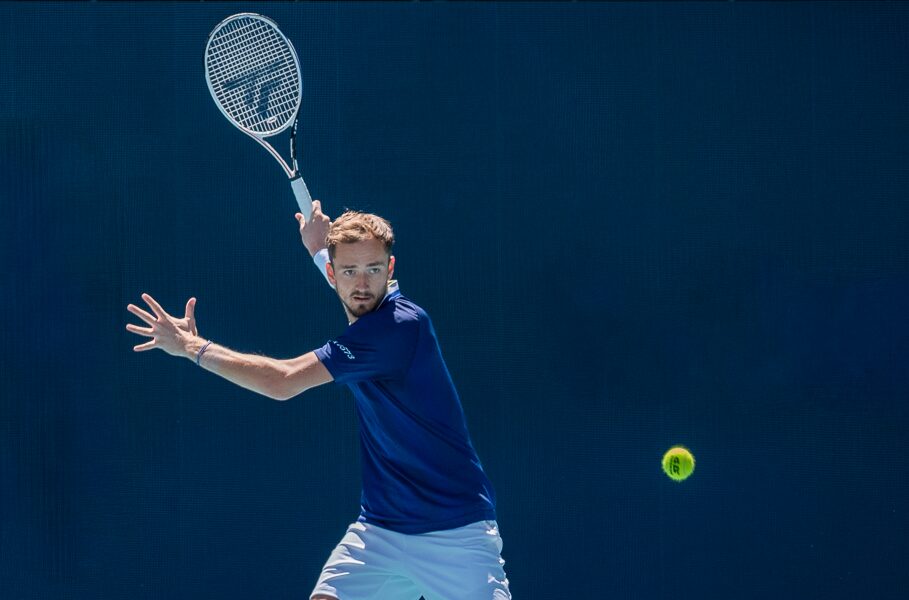
Daniil Medvedev has once again voiced his frustration with the Australian Open’s late-night scheduling, urging organizers to shift the start of evening sessions an hour earlier to curb matches that drag into the early morning hours. Speaking after his straight-sets victory at the Brisbane International, the Russian player highlighted how the current 7:00 p.m. kickoff on the main courts often leads to unfair conditions for players, fans, and staff alike.
Medvedev, a three-time finalist at Melbourne Park, made his comments on Monday following a 6-2, 6-3 win over Hungary’s Marton Fucsovics in the opening round. He pointed out that the tournament’s structure, which features two matches per night session on Rod Laver Arena and Margaret Court Arena, sets the stage for prolonged evenings when rallies turn epic or sets extend deep.
“It never will change, because TV’s controlling everything,” Medvedev said, acknowledging the influence of broadcasters in dictating start times. “I think there is always a reason why it starts at 7:00 p.m. and not 6:00 p.m.”
Despite his resignation to the status quo, Medvedev didn’t hold back on why an adjustment makes sense. He drew a parallel to his own viewing habits, noting how time zones affect enjoyment of other sports. “I like soccer, but here I don’t watch the Premier League because it’s at two in the morning,” he explained. “It’s pretty much the same—people who really love tennis would like to see it at six because then they are almost sure to watch both matches. OK, if it goes ridiculously long, instead of finishing at three, it would finish at two. It’s better for everyone.”
The 29-year-old’s plea isn’t new, but it carries weight given his personal history with marathon matches at the Australian Open. Just a year ago, in 2025, Medvedev suffered a defeat to American teenager Learner Tien in a contest that wrapped up at 2:55 a.m. The year before that, during his run to the 2024 final, he outlasted Finland’s Emil Ruusuvuori in a second-round battle that didn’t conclude until 3:39 a.m.
Those experiences, he said, underscore the physical and mental toll of playing into the dawn. “I don’t think it will ever change,” he added after his Brisbane win. “And again, I’m happy to play the night session if I need to, and I would not cry about it.”
Medvedev’s remarks echo a broader debate in tennis about scheduling and player welfare, particularly at Grand Slams where best-of-five-set formats can amplify delays. The Australian Open has long held a reputation for these nocturnal epics, with records dating back nearly two decades.
In 2008, local hero Lleyton Hewitt defeated Marcos Baghdatis in a match that ended at 4:34 a.m., still the latest finish in Grand Slam history. More recently, in 2023, Andy Murray’s grueling five-hour, 45-minute victory over Thanasi Kokkinakis concluded at 4:05 a.m., prompting the Briton to label the setup “a farce” and call for reforms.
Other players have joined the chorus over the years. Murray, a three-time major champion, argued post-match that such late finishes harm recovery and performance, especially in a tournament that spans two weeks under Australia’s summer heat. Novak Djokovic, another frequent night-session participant, has suggested limiting the number of matches per session or enforcing stricter time cutoffs.
Even tournament director Craig Tiley has acknowledged the issue, implementing minor tweaks like starting day sessions earlier in recent years, but the night program remains anchored at 7:00 p.m. to maximize global viewership and revenue.
Broadcasters, particularly in the U.S. and Europe, benefit from the timing, as it aligns with prime-time slots in key markets. ESPN, which holds U.S. rights, and other international partners prioritize accessibility for their audiences, often at the expense of on-site logistics in Melbourne.
Tiley has defended the schedule, noting in past press conferences that it balances commercial needs with competitive integrity. However, with player burnout a growing concern—evidenced by the ATP and WTA’s ongoing discussions on tour calendars—the push for change persists.
Medvedev believes his views resonate across the locker room. “I think all the players would agree,” he said in a separate interview last week, emphasizing that starting at 7:00 p.m. is “just asking for trouble” when five-setters are involved.
His own encounters with late nights extend beyond Australia; at the 2023 U.S. Open, he endured multiple post-midnight finishes before reaching the final. Yet, he remains pragmatic, focusing on what he can control as he gears up for the 2026 Australian Open, set to begin on January 18.
This season, Medvedev has shown solid form in the lead-up events. After his Brisbane opener, he advanced further in the tournament, building momentum after a mixed 2025 where injuries hampered his consistency.
Ranked No. 13 heading into 2026, he’s no longer the top seed he once was, but his tactical acumen and baseline resilience make him a perennial threat. In Brisbane, he displayed sharp serving and efficient groundstrokes, dispatching opponents with minimal drama—a contrast to the endurance tests he’s critiquing.
The Australian Open’s scheduling challenges aren’t unique to Medvedev. In 2025, several matches spilled over, including a third-round clash involving Felix Auger-Aliassime that pushed into the early hours.
Organizers responded by occasionally shifting start times on outer courts, but the show courts stayed rigid. For fans in the stands, late finishes mean disrupted travel and fatigue, while television audiences enjoy the drama without the inconvenience.
As the tournament approaches, Medvedev’s comments have sparked renewed discussion on social media and among pundits. Some argue that the allure of late-night tennis adds to the event’s mystique, drawing comparisons to other sports like cricket’s day-night Tests. Others side with players, prioritizing health over spectacle. The Professional Tennis Players Association (PTPA), co-founded by Djokovic, has flagged scheduling as a key issue in its advocacy efforts.
For now, Medvedev prepares for another Melbourne campaign, knowing the night sessions await. Whether his call prompts action remains doubtful, as he himself concedes. But by speaking out, he keeps the conversation alive, reminding stakeholders that while tennis thrives on endurance, there’s a line between competition and exhaustion.
As the first Grand Slam of the year looms, all eyes will be on whether Melbourne Park can find a middle ground—or if the wee hours will claim more victims.