

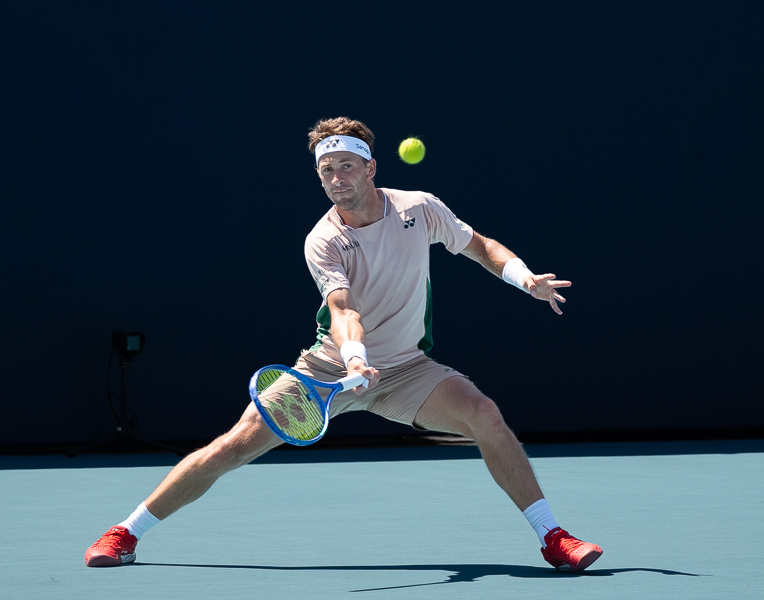
Casper Ruud was first understood as a clay-court player: heavy forehand, high margin, relentless discipline. Over time, he’s become something more interesting. The forehand is still the center of gravity, but his ability to compete deep into big events has come from turning that identity into a reliable week-to-week formula rather than a surface-only skillset.
Ruud’s tennis is built on professionalism. He rarely beats himself. He wins the matches he’s supposed to win, and when conditions suit him, he can pressure anyone.
Quick facts
- Tour: ATP
- Plays: Right-handed, two-handed backhand
- dentity: Forehand-led baseliner with high consistency and strong fitness
- Best-known surface: Clay
- Signature trait: Heavy, repeatable forehand patterns with low error rate
Snapshot
Ruud wins with shape and discipline. He uses topspin and depth to push opponents back, then looks for forehand openings to dictate. He’s not the tour’s most explosive attacker. He’s something more stable: a player who can hold his level for long stretches and force opponents to produce the highlight shots to beat him.
His effectiveness rises sharply on clay, where his forehand bounce and movement advantage become harder to neutralize.
Playing style and strengths
Forehand as the primary weapon
Ruud’s forehand is heavy and repeatable. He can hit it crosscourt with margin, then step into the line when he sees the opening. On clay, that forehand gets even more dangerous because it jumps.
High-percentage patterns
He doesn’t chase low-percentage winners early. He builds points, keeps the ball deep, and waits for the moment to accelerate. That makes him hard to dislodge.
Fitness and baseline endurance
Ruud’s physical level is a major part of his profile. In long matches, he often looks more comfortable as rallies extend.
Clay movement and point construction
On clay, he slides well, defends corners, and resets points without panicking. That’s the foundation of his best results.
Pressure points and vulnerabilities
- On very fast courts, his patterns can feel less effective because opponents can take the ball early and finish points quickly.
- If his backhand is rushed, he can get pinned and lose forehand opportunities.
- Against elite first-strikers, he may need to take more initiative than his natural style prefers.
His hardest matchups tend to be against players who can take time away and refuse long rallies.
Career milestones
Ruud’s career has been defined by consistency and clay-court excellence, with repeated deep runs at major tournaments that confirm his ability to manage a season and peak at the right moments.
His progression has been less about discovering new tools and more about applying his existing tools at a higher level under pressure.
Grand Slam record in context
Ruud’s Slam identity is tied to clay and to conditions that reward patience. Over best-of-five, his ability to avoid sloppy stretches makes him a dangerous opponent, especially in slower environments.
When he pushes deep at majors, the story is usually the same: his patterns hold, his forehand controls space, and he forces opponents to take risks for hours.
Ranking and season context
Ruud’s ranking value is built on reliability. He accumulates points steadily, especially during clay stretches, and his baseline level keeps him from frequent early exits.
What to watch next
The key for Ruud is how well he can carry his clay identity into faster conditions.
If his serve and backhand hold up enough to keep him in first-strike exchanges, he becomes a genuine all-surface threat. If not, his best weeks will continue to cluster around clay and slower hard courts.