

The US Open is the only Grand Slam in tennis history to have been played on three different surfaces. It started on grass, briefly experimented with clay, and has been played on hard courts since 1978 — a change that coincided with a new venue, a new city identity, and a fundamental shift in the kind of tennis the tournament produces. Here is the full story of how that transformation happened and what it changed.
The Grass Era: Newport to Forest Hills (1881–1974)
The tournament that would eventually become the US Open began in 1881 at the Newport Casino in Newport, Rhode Island, on grass courts. At the time, grass was the dominant surface for tennis across the world — Wimbledon had been played on it since 1877, and the sport’s upper-class origins in the manicured lawns of English country houses meant that grass was simply what serious tennis was played on.
The tournament moved to the West Side Tennis Club in Forest Hills, Queens, in 1915, eventually settling permanently there after a brief stint at the Germantown Cricket Club in Philadelphia in the early 1920s.
The Forest Hills venue opened a 14,000-seat stadium in 1924, and the US National Championships — as it was still called — became one of the premier annual sporting events in the United States.
The grass era produced champions who were products of a surface that rewarded serving, net play, and low, skidding groundstrokes. The great names of the pre-Open Era — Bill Tilden, Don Budge, Jack Kramer, Pancho Gonzales, Rod Laver — all competed on the grass of Forest Hills.
When the Open Era began in 1968, opening professional players to Grand Slam competition for the first time, the West Side Tennis Club was still a grass venue, and it produced two more grass-court US Open champions: Arthur Ashe in 1968 and Stan Smith in 1971, among others. Jimmy Connors won the final grass-court US Open in 1974.
The 1970 Tiebreak: The US Open Rewrites Tennis Scoring
Before the surface changed, the US Open made another revolutionary change to the sport. In 1970, at Forest Hills, the US Open became the first Grand Slam tournament to introduce the tiebreak — the most significant scoring innovation in modern tennis history.
The tiebreak was the invention of Jimmy Van Alen, a wealthy Newport tennis enthusiast and founder of the International Tennis Hall of Fame, who had spent two decades advocating for a way to shorten matches and make tennis more television-friendly. Bill Talbert, the US Open tournament director, agreed to test Van Alen’s system in 1970 in what was officially called the “nine-point sudden-death tiebreak” — a first-to-five-points format with a sudden-death point at 4–4 if the score reached that level.
The introduction was visible. When a set reached 6–6, a red flag bearing the letters “S” and “D” (for Sudden Death) and a smaller “V” crossed with an “A” (for Van Alen) was raised at the chair umpire’s seat. Arthur Ashe described it at the time: “It’s eerie what the tiebreakers do. Those red flags are out and the crowd is absolutely silent.”
Most of the top players disliked the format. The matches felt too short. The fate of an entire set could turn on a single sudden-death point. But the fans loved it, the television broadcasters loved it, and the New York Times called the change “the most revolutionary step the sport has ever taken in its scoring system.”
The nine-point sudden-death tiebreak eventually gave way to the more familiar first-to-seven-points format with a two-point margin requirement — the version used at every Grand Slam today. But the US Open’s willingness to be the first major to try a wholesale rewrite of how tennis was scored set the pattern for everything that would follow. When the surface change came four years later, the institution had already established itself as the Grand Slam most willing to experiment.
The Brief Clay Experiment: 1975–1977
In 1975, the USTA made a decision that surprised the tennis world: the grass courts at Forest Hills were converted to Har-Tru, a green clay surface made from crushed igneous basalt. The change was driven by two factors.
Complaints about the unpredictability of the grass bounce had grown louder — the Forest Hills surface was widely regarded as among the least consistent in major tennis, with its heavily worn patches producing erratic, unreliable bounces that frustrated players.
At the same time, tournament officials were looking for ways to make the event more television friendly, and the slower green clay surface produced longer rallies and more sustained baseline exchanges, which broadcast executives believed would hold viewers better than the short, sharp points of grass-court tennis.
Floodlights were installed for the clay years, enabling night sessions for the first time — a change that proved so popular it would be retained permanently when the surface changed again.
The three-year clay era produced three distinct champions in each discipline. On the men’s side, Manuel Orantes won in 1975, Jimmy Connors in 1976, and Guillermo Vilas in 1977. On the women’s side, Chris Evert won all three editions.
Connors’s 1976 victory was notable for its opponent: he defeated Björn Borg in the final, beating the reigning French Open champion on clay — the very surface Borg owned — a result that underlined the difference between the American green clay and the red clay of Paris.
Vilas’s 1977 title was part of an extraordinary season in which he won 59 singles matches in a row at one point, finishing the year with 145 wins and just 14 losses.
Despite the quality of the tennis produced, the clay era did not outlast its initial trial. Three years was long enough for the USTA to conclude that the green clay experiment had served its purpose, and when the tournament moved venues in 1978, the opportunity arose to change the surface one final time.
The 1978 Move to Flushing Meadows and Hard Courts
The USTA National Tennis Center in Flushing Meadows, Queens, opened in 1978 — and with it came the hard court surface that has defined the US Open ever since. The new facility was built specifically to accommodate the rapid growth of professional tennis and the tournament’s expanding commercial ambitions. Forest Hills had charm, but it was fundamentally a private club with a public tennis tournament bolted onto it. Flushing Meadows was purpose-built for scale.
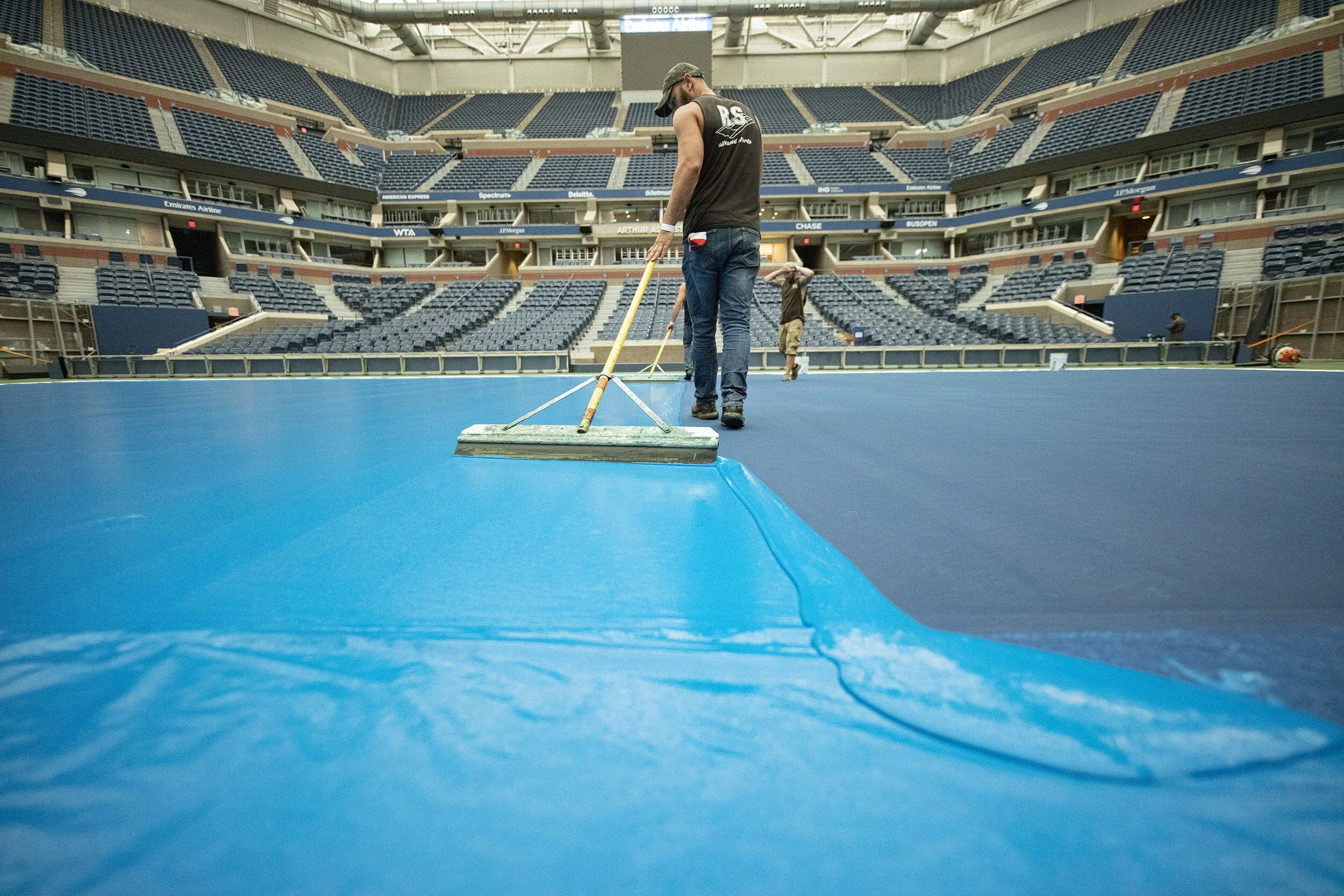
The surface chosen was DecoTurf, a rubberized acrylic hard-court compound manufactured by California Products Corporation. In its early years at Flushing Meadows, the courts were painted green — the same color the venue had used on clay, and a holdover from the previous era’s visual identity.
It wasn’t until 2005 that the inside of the courts was repainted blue, creating the distinctive color scheme that is now synonymous with the US Open. The blue court with the green surrounds — introduced as part of a broader site renovation — was retained through all subsequent changes to the specific surface product used.
In 2020, DecoTurf was replaced after 41 years by Laykold, manufactured by Advanced Polymer Technology. The switch was driven by the desire to find a surface better suited to the hot and humid late-August conditions at Flushing Meadows.
Laykold was already in use at the New York Open and the Miami Masters, and tournament officials were confident it would perform more reliably in the specific environmental conditions the US Open presents.
The playing characteristics of the two surfaces are similar — both are classified as medium-slow hard courts — but the Laykold surface was designed with improved heat dissipation properties.
How Hard Courts Changed the Style of Play
The switch from grass to hard courts — even via the brief clay interlude — fundamentally changed the kind of tennis the US Open rewarded and therefore the kind of player who could win it.
On grass, serving and net play dominated. Points were short, volleys were decisive, and the serve-and-volley game that ruled professional tennis from the 1950s through the 1970s found its best expression at the net. Forest Hills produced champions who came forward: Connors, Ashe, Smith, Laver. The game was fast, low, and decided in a flurry of net exchanges.
Hard courts changed that equation in several ways. The bounce is higher and more consistent than on grass, giving baseliners more time to set up and more reliable contact points. The surface is fast enough to reward a big serve, but not so fast that the serve dominates completely.
It produces a middle ground that suits a broader range of players than either grass or clay, which is part of why the hard-court era of the US Open produced a much more diverse roster of champions.
The baseline game, which had been at a structural disadvantage on grass, became viable and then dominant. Ivan Lendl — who had struggled on the serve-and-volley grass of Forest Hills in his early career — won three US Open titles on hard courts between 1985 and 1987, each time rewarded by a surface that suited his powerful, relentless baseline game.
Pete Sampras won five US Open titles on hard courts by combining a dominant serve with hard-court athleticism in a way that translated far less effectively to clay. Serena Williams, whose serve-baseline combination was ideally suited to a medium-fast hard court, won six US Open titles — the most of any player in the Open Era.
What the Move Meant for American Players
The shift to hard courts had particular significance for American tennis. The United States had historically struggled on red clay — the surface that rewarded the grinding, high-topspin baseline game of Spain and South America — and the brief green clay era at Forest Hills had not fundamentally altered that picture, even though American players performed reasonably well on the faster American green clay.
Hard courts were, and remain, the dominant surface in the United States at club level. American players grew up on hard courts, developed their games on hard courts, and were most comfortable on hard courts.
The move to a permanent hard-court US Open aligned the tournament’s surface with the surface that American players knew best — a structural advantage that contributed to a long period of American dominance at Flushing Meadows through the 1980s, 1990s, and 2000s.
The contrast with Roland Garros is instructive. American players have won the French Open 13 times since 1968, compared to dozens of titles for Spain alone. At the US Open on hard courts, American players have been among the most successful in the tournament’s history.
Jimmy Connors: The Only Player to Win on All Three Surfaces
The surface transitions at the US Open created one of the sport’s most remarkable statistical footnotes. Jimmy Connors is the only player in history to have won the US Open on three different surfaces — grass in 1974, clay in 1976, and hard courts in 1978, 1982, and 1983. His five US Open titles span all three eras and stand as a testament to an adaptability that no other player has matched at this tournament.
On the women’s side, Chris Evert is the only player to have won the US Open on two surfaces — clay in 1975, 1976, and 1977, and hard courts in 1978, 1980, 1982, and 1984. Her 1978 hard court title came in the very first year the tournament played at Flushing Meadows, making her the last US Open clay court champion and the first US Open hard court champion in successive years.
The Venue Transformation: From Private Club to New York Institution
The surface change was inseparable from the venue change, and the venue change transformed what the US Open was as an event. Forest Hills, for all its history, was a private tennis club in a residential neighbourhood. It had atmosphere and tradition, but it was not built for the commercial and cultural ambitions that professional tennis was developing in the late 1970s.
Flushing Meadows changed everything. The new USTA National Tennis Center was a public facility — built on public land in a public park — designed from the outset to be a major entertainment venue as well as a sporting one.
The immediate increase in capacity, the accessibility of the new location via subway, and the night session infrastructure that came with the new venue all contributed to a rapid rise in attendance and television viewership.
In 1997, the opening of Arthur Ashe Stadium — named after the man who had won the inaugural US Open on the grass of Forest Hills in 1968 — gave the tournament the largest tennis arena in the world, with over 23,000 seats.
The stadium’s 2016 retractable roof completed a transformation that had begun with the decision to pour a hard court surface on a former wild marshland in Queens nearly four decades earlier.
The Bottom Line
The US Open’s three surfaces are not merely a curiosity of tennis history. They represent three distinct identities for a tournament that has never been content to stay still. The grass era produced serve-and-volley champions on a club lawn in Queens. The three-year clay experiment produced baseline grinders and television-friendly rallies.
And the hard court era — now approaching its fiftieth year at Flushing Meadows — produced the US Open as the world knows it today: loud, fast, commercially dominant, and set on a blue acrylic court in a 23,000-seat stadium that could not be more different from the manicured lawns of Newport, Rhode Island, where it all began in 1881.