

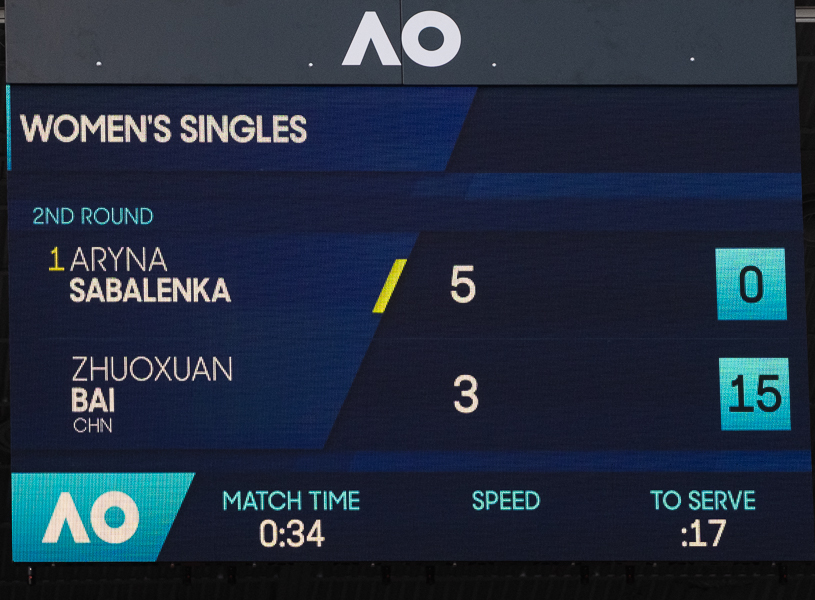
Tennis scoring looks strange until you see the structure. A match is built in layers: points make games, games make sets, and sets decide the match.
This guide explains the full scoring system in plain English, including why 40 exists, what “deuce” means, how tiebreaks work, and how match formats differ across the sport.
The Basic Building Blocks
A tennis match is made of:
- Points (0, 15, 30, 40)
- Games (first to win 4 points with a 2-point margin)
- Sets (usually first to 6 games with a 2-game margin)
- Match (best of 3 sets or best of 5 sets)
If you understand those four layers, you understand tennis scoring.
Points: Love, 15, 30, 40
In a standard game, the score goes:
- 0 = Love
- 1 point = 15
- 2 points = 30
- 3 points = 40
- 4th point wins the game if you’re ahead by at least two points
Example progression:
- Love–Love → 15–Love → 30–15 → 40–30 → Game
What Is Deuce?
When both players reach 40–40, the score is deuce.
From deuce, a player must win two consecutive points to win the game.
- Win one point after deuce → Advantage (often written “Ad”)
- If you win the next point → you win the game
- If you lose the next point → the score returns to deuce
So a deuce game can extend for a long time: it’s a two-point margin requirement.
Games: How You Win a Game
You win a game by:
- winning at least 4 points, and
- being at least 2 points ahead
That’s why 40–30 can become deuce, and why deuce can loop until someone wins two in a row.
What Is a Break of Serve?
Players usually serve one full game at a time, then the other player serves the next game. A break of serve happens when the returner wins the game on the opponent’s serve. Breaks are a big deal because serving is normally an advantage.
Sets: How You Win a Set
Most sets are won by:
- first to 6 games, with
- a 2-game margin
So a player can win a set:
- 6–0, 6–1, 6–2, 6–3, 6–4
- or 7–5 (because 6–5 is only a one-game margin)
If the set reaches 6–6, most events use a tiebreak to decide it.
Tiebreaks: What Happens at 6–6
A standard tiebreak is usually:
- first to 7 points, with
- a 2-point margin
So you can win a tiebreak 7–5, 8–6, 10–8, etc.
Tiebreak scoring is normal counting: 1, 2, 3, 4…
The tiebreak winner also wins the set, typically 7–6.
Match Format: Best of 3 vs Best of 5
Most professional matches are best of three sets.
- Win 2 sets → win the match
Men’s singles at Grand Slams are typically best of five sets.
- Win 3 sets → win the match
Women’s singles at Grand Slams are best of three sets.
Doubles formats vary more and sometimes use match tiebreaks instead of a full third set.
Final Set Rules
Rules for deciding sets (final sets) can differ by event.
Many tournaments now use a final-set tiebreak rather than “play until someone wins by two games.” At the Grand Slams, the deciding-set format is standardized around a final-set tiebreak played at 6–6.
If you want the full breakdown, see our separate tiebreak explainer (coming next).
Common Scoreline Examples
- 6–3, 6–4 (straight sets win in best-of-three)
- 7–6, 4–6, 6–2 (three-set match with a tiebreak)
- 6–2, 3–6, 7–5 (deciding set without a tiebreak at 6–6)
Frequently Asked Questions
Why is 0 called love?
It’s tradition, likely tied to French influence in early tennis scoring. The exact origin is debated, but the term is universal.
Why does tennis use 15–30–40?
The most common explanation ties it to historical timekeeping systems, but the modern game simply inherited it.
What does “Ad” mean?
Advantage. It means a player is one point away from winning a deuce game.
Is every set decided by a tiebreak at 6–6?
Most are, but formats can vary, especially in deciding sets and in doubles.