

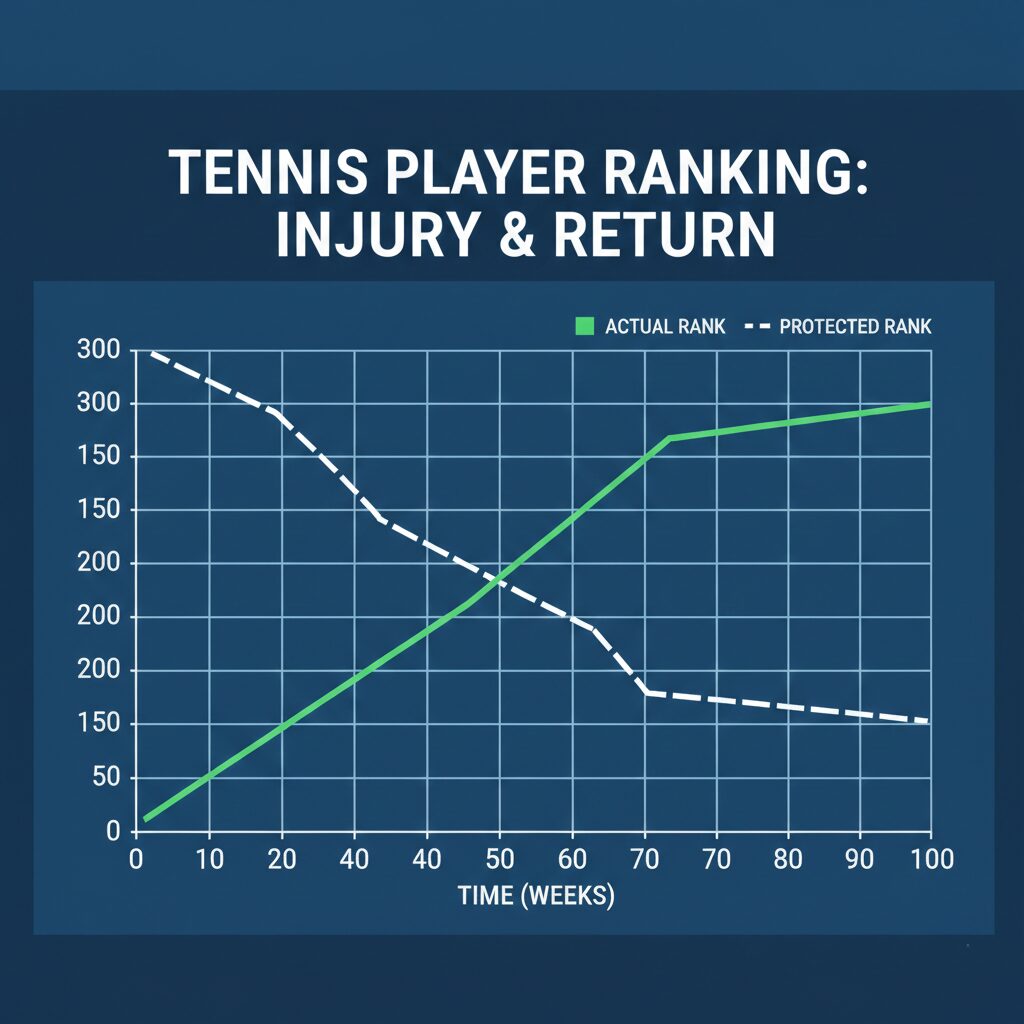
A tennis ranking is a rolling 52-week total. It rewards recent results and forgets old ones, which means a player who stops competing does not hold position — they fall, week by week, as points earned a year earlier drop off and nothing replaces them. A long injury can take a top-20 player outside the range where tournaments accept entries at all.
The protected ranking exists to stop that fall from ending a career. It lets a player who has been away for a qualifying reason enter tournaments using a frozen version of their old ranking rather than their diminished current one. The ATP calls it a Protected Ranking. The WTA calls it a Special Ranking. They work toward the same end and differ in nearly every detail.
What a Protected Ranking Is and Is Not
The critical thing to understand is that a protected ranking is an entry mechanism and nothing more. It gets a player into a draw. It does not give them a seeding, it does not restore their real ranking, and it does not protect them from falling further if they lose when they come back.
This places it alongside the other routes into a professional draw. Direct acceptance is earned by current ranking. Wild cards are granted at a tournament’s discretion. Qualifying is won on court. A protected ranking is the fourth door, and it is the only one a player earns by having been absent.
The ATP Protected Ranking
Who qualifies
A player becomes eligible after a minimum six-month absence from all tennis events, for physical injury, documented medical illness, or compulsory military service. The absence must be genuine and total — competing anywhere during the qualifying period breaks it.
The player petitions the ATP CEO or a designee in writing, and the petition must arrive within six months of their last tournament. Medical documentation from a treating physician is required where the ground is injury or illness.
How the number is calculated
The protected ranking is not the player’s ranking on the day they stopped playing. It is the average of their ranking positions across the first three months after their last event.
That distinction matters. A player who was ranked No. 8 when injured but slid to No. 15 over the following twelve weeks does not get No. 8. They get something between the two.
How long it lasts and how often it can be used
The allowance scales with the length of the absence, and it runs on two clocks at once — a count of tournaments and a stretch of time, whichever expires first.
A six-month absence permits use at the first nine tournaments the player enters using the protection, or for nine months from their first event back. An absence of twelve months or longer extends this to twelve singles tournaments and, separately, twelve doubles tournaments, or twelve months.
Two limits sit on top of that. Use at any single Grand Slam is capped at once per event, and the United Cup does not count against the allowance at all. Entries made as a wild card, or as a direct acceptance on the player’s real ranking, do not consume a use either.
The WTA Special Ranking
Wider grounds, longer reach
The WTA requires an Out-of-Competition Period of 26 weeks, but the grounds are broader than the ATP’s. Alongside medical conditions, the WTA recognises pregnancy and parental start, and it maintains separate rules for two situations the men’s tour does not address at all — a Fertility Protection Special Entry Ranking, and a distinct return-to-competition ranking for players coming back under the anti-doping programme.
This asymmetry is the single biggest structural difference between the two systems. The ATP framework is built around injury. The WTA framework is built around any extended absence a professional career might involve.
Where it can be used
The WTA caps the tournament level as well as the number of entries. A player may use her Special Ranking at a maximum of five WTA 1000 Mandatory tournaments and two Grand Slams within her total allowance, and she must notify WTA Operations in writing before the relevant entry deadline to use it at either.
Entering singles and doubles at the same tournament on a Special Ranking counts as a single use, not two. A player may also freeze her Special Ranking period, pausing the clock, a maximum of twice per Special Ranking — a provision that matters when a comeback is interrupted by a fresh injury.
What a Protected Ranking Cannot Do
Both tours draw the same hard line in the same place. A protected ranking is for entry. It cannot be used for seeding, which means a returning former top-10 player can be drawn against anyone in the first round. It cannot be used for lucky loser consideration. It cannot be used to qualify for the season-ending finals.
The WTA adds that Special Rankings are not used to determine which players count as Top 10 Players for the purposes of its rules on tournament acceptance and appearances.
The practical consequence is that a protected ranking buys a player a place in the draw and nothing else. Everything after that has to be won.
| Aspect | ATP Protected Ranking | WTA Special Ranking |
|---|---|---|
| Minimum absence | 6 months | 26 weeks |
| Qualifying grounds | Injury, documented illness, military service | Medical, pregnancy, parental start, plus separate fertility and anti-doping return rules |
| How it is calculated | Average ranking across the first 3 months after the last event | Set under the Special Ranking rule in the WTA rulebook |
| Grand Slam limit | Once per Grand Slam event | Maximum of 2 Grand Slams |
| Top-tier event limit | Governed by the overall tournament allowance | Maximum of 5 WTA 1000 Mandatory tournaments |
| Seeding | Not permitted | Not permitted |
Season Snapshot — August 2026
Volatile detail, accurate as of publication. The rules above are stable; the items below are not.
- The ATP cut the number of results counting toward a ranking to 18 in its 2026 rulebook. Protected ranking rules were not changed by that revision.
- The WTA maintains its Fertility Protection Special Entry Ranking as a separate section of the rulebook, distinct from the Special Ranking rule itself.
- Both tours publish current thresholds in their official rulebooks, and usage caps have been revised more than once. Figures should be checked against the current edition before being relied on.
Frequently Asked Questions
Does a protected ranking get a player seeded?
No. This is the most common misunderstanding. On both tours the protection covers entry only, which is why a returning major champion can land in a top seed’s section of the draw in the first round.
Can a player use a protected ranking and their real ranking in the same season?
Yes. If a player’s actual ranking is high enough to get them into a tournament directly, that entry does not consume one of their protected uses. The protection is only drawn on when it is needed.
Is a protected ranking the same as a wild card?
No. A wild card is discretionary and granted by a tournament to whomever it chooses. A protected ranking is an entitlement a player qualifies for under tour rules, and the tournament has no say in it.
What happens when the protection runs out?
The player competes on whatever ranking their results have rebuilt. If the comeback has gone well, the real ranking has recovered. If it has not, the player faces qualifying or the lower tiers like anyone else.
Who has used one?
The mechanism is common at the top of the game after long layoffs. Naomi Osaka returned under the WTA’s maternity provisions, and Rafael Nadal used the ATP protection during the injury-hit final phase of his career. Access, though, is all it provides — the results still have to follow.