

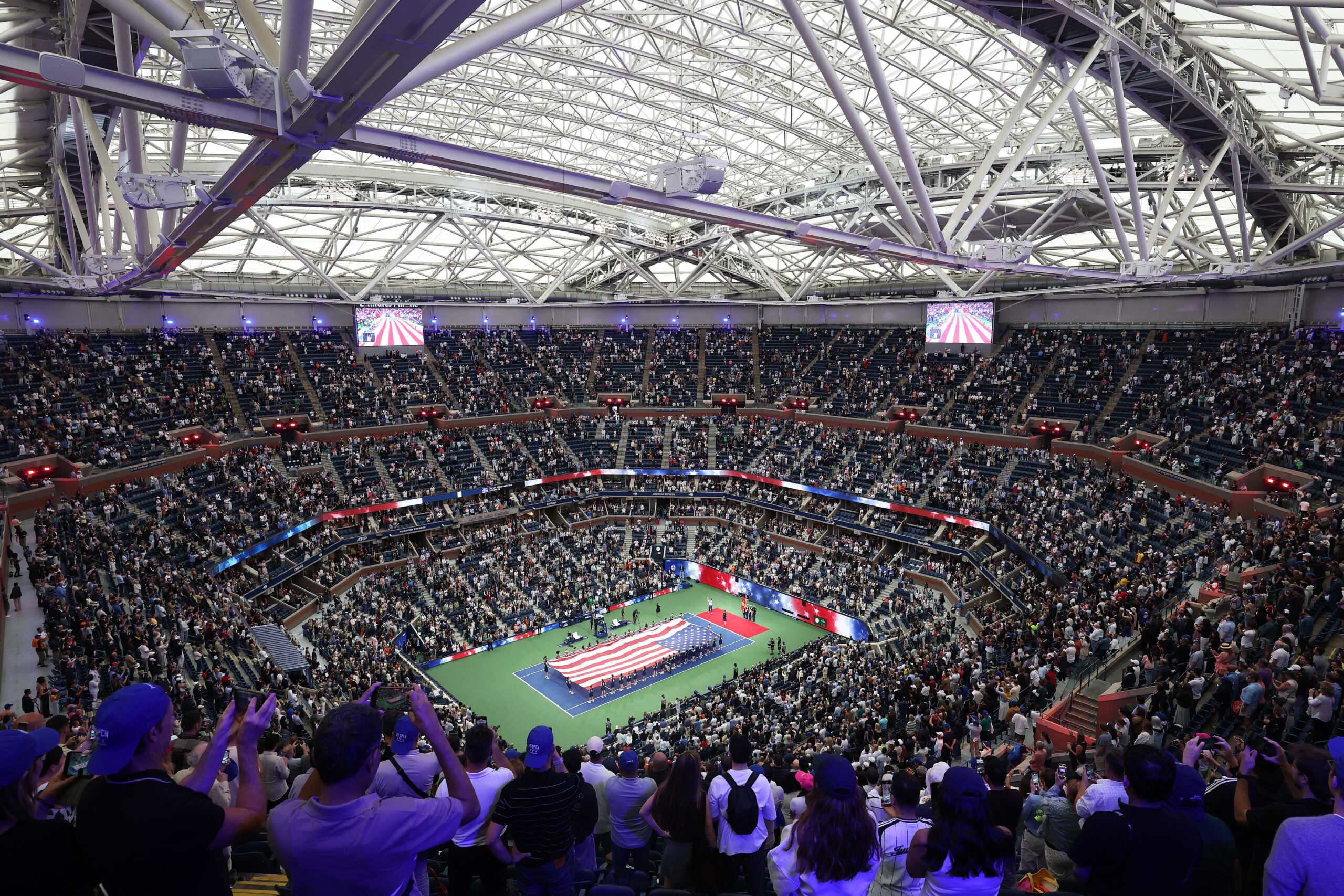
Every Grand Slam has a personality. Wimbledon is hushed and reverential. Roland Garros is passionate but contained. The Australian Open is relaxed and festival-like. And then there is the US Open — a tournament that Frances Tiafoe once described as “insane loud,” that Novak Djokovic called “the biggest stadium and the loudest stadium in our sport,” and that sports journalist Molly McElwee compared to a soccer match rather than a tennis tournament.
The noise at Flushing Meadows is not accidental. It is the product of architecture, geography, culture, and New York City itself.
It Starts With the Stadium
Arthur Ashe Stadium holds 23,859 spectators, making it the largest tennis arena in the world by a significant margin. The next largest Grand Slam main court — Roland Garros’s Court Philippe-Chatrier — holds around 15,225. Wimbledon’s Centre Court holds approximately 15,000. Rod Laver Arena in Melbourne holds around 15,000.
Arthur Ashe Stadium seats roughly 9,000 more people than the next biggest Grand Slam center court. Nine thousand more people making noise, reacting to points, rising to their feet — that difference alone would make the US Open louder than any other major.
But sheer capacity is only part of the story. The geometry of Arthur Ashe Stadium amplifies the crowd in ways that a simple headcount cannot capture. The stands rise steeply around the court, enclosing it in a near-continuous wall of spectators.
When 23,000 people react simultaneously to a match point or an unexpected winner, the sound that results is genuinely unlike anything in tennis — and, as several players have noted, unlike anything in most sports.
The Roof Made It Louder
In 2016, Arthur Ashe Stadium gained a retractable roof — a $150 million structure that is the largest retractable opening in tennis. It was built to protect matches from New York’s late-summer rainstorms, which had historically caused significant scheduling disruption at the tournament. It solved that problem. It also, somewhat unexpectedly, created a new one: noise.
When the roof is closed, the stadium becomes an acoustic chamber. The crowd noise that would previously have dissipated upward into the open sky is instead reflected back down into the bowl of the arena.
During the roof’s debut in 2016, Rafael Nadal observed that even when the roof was only partially closed, the noise level inside the arena was noticeably different from what he had experienced at previous US Opens. The chair umpire attempted to quiet the crowd at least fifteen times during one match alone — to no effect whatsoever.
The roof’s acoustic material was not designed with sound absorption as a primary goal, in contrast to the roof on Court Philippe-Chatrier at Roland Garros, which uses composite materials engineered to absorb around 65 percent of ambient sound. The result at Arthur Ashe is a covered environment that, when full, is arguably the loudest indoor sporting arena in the world.
The Planes and the Trains
The noise at the US Open is not confined to the crowd. The USTA Billie Jean King National Tennis Center sits in Flushing Meadows, Queens — less than five miles from LaGuardia Airport.
Aircraft on their departure paths climb directly over the complex throughout the day and evening, producing a low overhead rumble that interrupts points with regularity and has been a source of frustration for players since the tournament moved to its current location in 1978. No other Grand Slam contends with regular aircraft noise of this kind during play.
The Flushing Meadows complex also sits adjacent to one of the busiest transit hubs in the New York Metropolitan Area. Trains on the 7 line — the subway that connects Midtown Manhattan to the grounds — run frequently throughout the tournament, and the sounds of the city’s infrastructure form a constant ambient backdrop to play on the outer courts that has no parallel at Wimbledon, Roland Garros, or Melbourne Park.
The Music Between Points
At Wimbledon, changeovers are quiet. The crowd settles, players towel off, and the grounds return to something close to silence. The US Open takes a different approach entirely. Music plays during changeovers on Arthur Ashe Stadium — loud, high-energy music, a rotating playlist that has included tracks like “Danza Kuduro” by Don Omar and “Move Your Feet” by Junior Senior.
The speakers that deliver this music to nearly 24,000 spectators are not operating at conversational volume. This practice reflects a deliberate philosophy at the US Open: the tournament wants to feel like a major entertainment event, not merely a sports competition.
The music keeps the crowd energized between games, maintains the atmosphere during slower patches of play, and signals to spectators that this is not an environment that demands or rewards the kind of decorum associated with the sport’s more traditional venues.
The contrast with Wimbledon — where applause at the wrong moment is still frowned upon in some quarters — could not be more stark.
The New York Crowd Is Different
The attitude of the crowd at Arthur Ashe Stadium is as important as its size. The US Open draws its audience primarily from New York City and the surrounding metropolitan area — one of the most sports-saturated cities in the world, where fans are accustomed to expressing themselves loudly and without much concern for convention.
These are people who attend Yankees games, Knicks games, Giants games. They bring those habits to Flushing Meadows.
The result is a crowd that cheers during points, reacts audibly to errors, and does not observe the tradition of silence during play that tennis etiquette technically demands. Players notice this immediately.
Martina Navratilova, who won on every surface and in every conceivable environment across her Hall of Fame career, noted that the noise at Arthur Ashe was uniquely disorienting — explaining that in tennis, you hear the ball before you see it, and that when that auditory signal is drowned out by crowd noise, tracking the ball becomes genuinely harder.
Caroline Garcia, who reached the 2022 US Open semifinals, was direct: the crowd in New York was noisier than at any other Grand Slam, full stop.
The size of the stadium also has an unexpected psychological effect. Because Arthur Ashe is so large, spectators in the upper tiers are far from the action and tend to move around, chat, and generally behave more like they are attending a large stadium event than a tennis match.
Some players find this liberating. Emma Navarro noted that the sense of not having every set of eyes in the building fixed on her was actually calming. Others find it destabilising — particularly when the background noise of 23,000 people conducting their own conversations becomes the sonic backdrop to a crucial moment in a match.
The Honey Deuce Effect
The US Open’s signature cocktail — the Honey Deuce, a combination of lemonade, vodka, and raspberry liqueur served in a branded cup — has become one of the tournament’s defining cultural symbols. The USTA reportedly sells around 40,000 of them per day during the tournament.
This detail is not merely trivia. A tournament crowd that has been drinking steadily through an August afternoon in New York is a crowd that is going to be louder, more uninhibited, and more volatile than the same crowd sober.
The free-flowing availability of alcohol throughout the grounds is a structural contributor to the atmosphere at Flushing Meadows in a way that is not true at Wimbledon or Roland Garros to the same degree.
How Players Respond to It
The US Open crowd divides players more clearly than at any other Grand Slam. Some thrive on it. Frances Tiafoe, who reached the 2022 semifinals, is perhaps the clearest example — a player who feeds off crowd energy, who rouses the Arthur Ashe audience deliberately, and who has described the atmosphere at the US Open as the greatest in sport. Tiafoe recalled facing Carlos Alcaraz there: the noise was such that 23,000 people felt like 23 million.
Serena Williams produced some of her most celebrated performances on this court precisely because her connection with the New York crowd was electric. The stadium wanted her to win, and its 23,000 occupants were not shy about communicating that.
When Williams played her farewell matches at the 2022 US Open, the atmosphere at Arthur Ashe was described by those present as unlike anything tennis had produced before.
But the same environment unnerves others. Players accustomed to the quieter, more structured atmospheres of Wimbledon or Roland Garros can find the constant background noise of Arthur Ashe genuinely disruptive.
The inability to hear the ball clearly, the unpredictability of when the crowd will react and how loudly, the sense that the audience is a participant in the match rather than a witness to it — these are genuine psychological challenges that require adjustment.
Not every player makes that adjustment successfully, and the US Open draw has historically produced its share of upsets from players who found the environment of Arthur Ashe simply too much to manage.
Is It Good for Tennis?
The US Open’s noise is a source of ongoing debate within the sport. Critics — often including players and traditionalists — argue that the crowd noise undermines the concentration that tennis demands, that it unfairly disadvantages certain players over others, and that the rowdy atmosphere is incompatible with the technical and mental demands of elite competition.
The US Open has the most unruly crowds in Grand Slam tennis, and this is not universally celebrated. Defenders argue the opposite: that the US Open crowd makes tennis more accessible, more exciting, and more relevant to a mainstream sports audience that would not engage with a quieter, more formal event.
The US Open has consistently been one of the most watched and most commercially successful Grand Slams, and the atmosphere at Arthur Ashe is a significant part of that appeal. The argument that diversity of environment strengthens the tour — that a Grand Slam that demands something genuinely different from players is a healthy thing — has real merit.
What is not in dispute is that the US Open feels different. It sounds different. It demands something different from the players who want to win it. And that difference — loud, chaotic, electric, unmistakably New York — is precisely what makes it one of the most compelling two weeks in tennis.
The Bottom Line
The US Open is the loudest Grand Slam because nearly everything about it conspires to produce noise: the biggest stadium in tennis, a roof that traps sound rather than releasing it, aircraft overhead, trains nearby, music between points, a crowd that doesn’t observe traditional tennis etiquette, and 40,000 Honey Deuces flowing through the stands every day. Each of those factors would contribute something on its own.
Together, they produce an atmosphere that has no equivalent in the sport — and that has defined the US Open’s identity as the most chaotic, most electric, and most unapologetically loud event in tennis.