

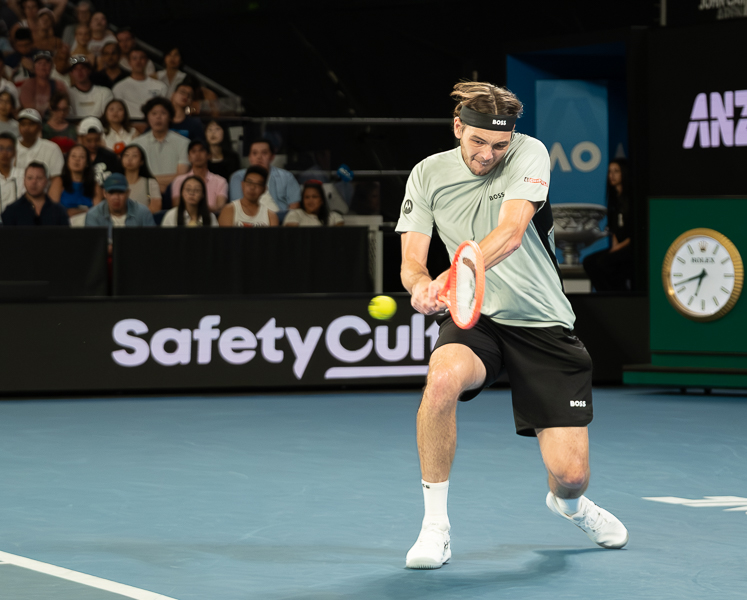
Taylor Fritz is the American prototype for the modern men’s tour: big serve, heavy forehand, clean backhand, and the willingness to play first-strike tennis without needing to rush. He’s not flashy. He’s efficient. And when conditions reward power and pace, he can look like a genuine title threat.
Fritz’s game is designed to win on hard courts, where serving holds weight and forehands can end points quickly. His progress over recent seasons has been about rounding out the parts that separate a top-10 regular from a Slam finalist.
Quick facts
- Tour: ATP
- lays: Right-handed, two-handed backhand
- Identity: Serve-plus-one attacker with a forehand-led baseline game
- Best-known surface: Hard courts
- Signature trait: Clean power with relatively low risk
Snapshot
Fritz wins by controlling the first few shots. He wants strong first serves, predictable forehand looks, and short patterns that prevent opponents from dragging him into long defensive sequences.
He’s most dangerous when he’s serving at a high percentage and stepping into the forehand early. When he starts defending too much, the match can drift away from his strengths.
Playing style and strengths
Serve as the starting point
Fritz’s serve sets the tone. When he’s landing first serves, he protects his service games with minimal drama and forces opponents to press on return games.
Forehand as the finishing tool
His forehand is the weapon. He likes to run patterns that open the court to the forehand side and then drive through the ball rather than relying on heavy spin.
Backhand stability
His backhand is solid enough that opponents can’t simply camp there. It holds the baseline and allows him to wait for forehand opportunities instead of being rushed into errors.
Comfort in fast conditions
On quicker hard courts and indoors, his combination of serve and flat pace becomes more valuable. Matches can turn into a handful of break chances and tiebreaks, which suits his profile.
Pressure points and vulnerabilities
- When forced into extended defense, he can lose his strike position and become reactive.
- Elite returners who neutralize his first serve can expose the “serve-plus-one” structure.
- On slower clay, finishing points requires more patience and construction, which can reduce his natural advantage.
His best matchups are against players who give him rhythm. His hardest matchups are against players who take away time and force him to hit extra balls.
Career milestones
Fritz’s rise has been defined by steady improvement rather than one sudden leap. He’s built credibility through strong results at major tour events, deep runs in high-tier weeks, and a growing ability to handle pressure matches against elite opponents.
He’s become a player who regularly expects to be seeded and regularly expects to reach later rounds.
Grand Slam record in context
In best-of-five, Fritz’s game has the tools to travel: serve, forehand, and the ability to play tiebreak tennis. The question at the Slam level is whether he can create enough return pressure across two weeks to avoid living and dying by a handful of points.
When he’s returning well, his ceiling rises sharply because his serve already gives him a stable base.
Ranking and season context
Fritz’s ranking strength is tied to reliability on hard courts and strong performance in big weeks where points compound quickly.
What to watch next
Fritz’s next step is usually defined by one thing: return pressure.
If he’s creating break chances regularly, he can win titles in the biggest non-Slam events and make real Slam runs. If he isn’t, he remains dangerous but vulnerable to small swings in tiebreak-heavy matches.