

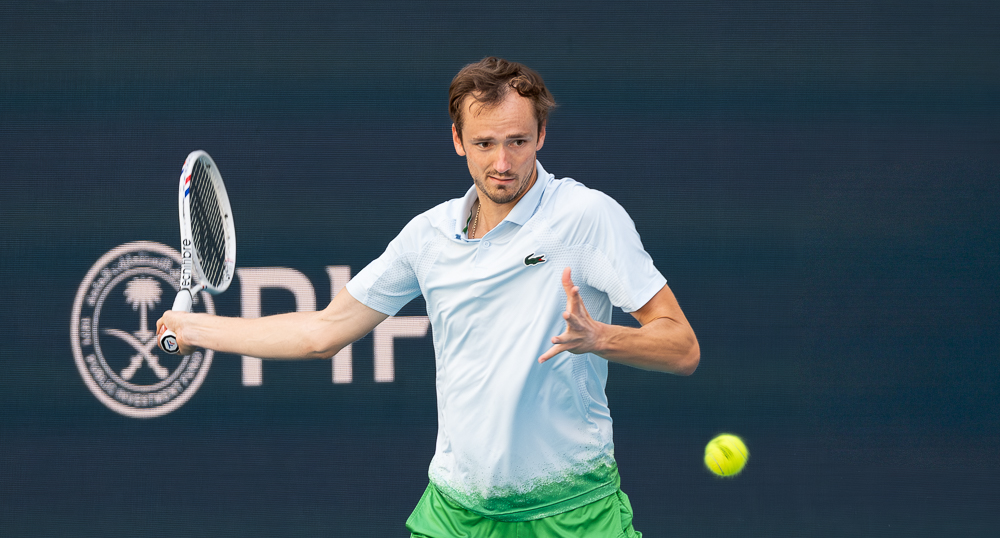
Daniil Medvedev has built a career on logic, patience, and a willingness to win ugly. His game is not designed to please purists. It’s designed to take time away from opponents and slowly remove their best options until they start missing.
In an era defined by explosive first strikes, Medvedev has often been the counterweight: deep court positioning, elastic defense, and a serve that quietly does enormous damage.
Quick facts
- Tour: ATP
- Plays: Right-handed, two-handed backhand
- Identity: Elite returner and counterpuncher with unusual court positioning
- Best-known surface: Hard courts
- Signature trait: Turning defense into pressure without looking like he’s attacking
Snapshot
Medvedev is a hard-court specialist with a tactical brain. He absorbs pace better than almost anyone, redirects flat through the court, and uses depth as a weapon. When he’s locked in, matches feel like slow suffocation: opponents hit bigger, take more risk, and eventually donate errors.
Playing style and strengths
Deep return position, deep rally position
Medvedev’s default posture is deeper than most top players, especially on return. He gives up court position to gain time, then uses that time to send the ball back heavier and deeper than opponents expect.
Serve as a points engine
His serve is a major reason he wins consistently on hard courts. It sets up predictable patterns: big first serves, safe second serves, and quick access to a backhand he trusts completely.
Flat backhand as a control tool
His two-hander is built for control and redirection. He can absorb huge forehands and send the ball back low, flat, and awkward, forcing opponents to generate their own pace repeatedly.
Defensive elasticity
Medvedev’s movement is deceptive. He slides on hard courts, reaches balls others don’t, and turns neutral rallies into extended tests of patience.
Weaknesses and pressure points
- When forced forward repeatedly, his transition game can be exposed.
- Very high-bouncing clay can push his strike zone up, making it harder to flatten the ball.
- Players who can finish at net or take the ball early can disrupt his rhythm.
His best opponents don’t try to out-rally him. They try to change the geometry.
Career milestones
Medvedev’s breakthrough came through big hard-court runs, followed by sustained seasons near the top of the tour. He became one of the defining figures of the post–Big Three transition years, often positioned as the player most capable of dismantling elite attackers over two weeks.
His résumé is built around deep runs at the biggest events, especially on hard courts, and a long stretch as a consistent top-tier contender.
Grand Slam record in context
Medvedev’s Slam identity is primarily hard-court centered. He’s been at his most dangerous at the Australian Open and US Open, where conditions reward serve quality, depth control, and the ability to win long baseline exchanges without leaking errors.
Over five sets, his greatest strength is psychological: he can play the same disciplined patterns for hours without getting bored.
Ranking and season context
Medvedev’s ranking value comes from reliability. Even in weeks where he doesn’t look brilliant, his baseline level often carries him into late rounds. When he peaks, he becomes one of the hardest matchups on tour because he forces opponents to win the match, rather than waiting for him to lose it.
What to watch next
Medvedev’s season often turns on two questions:
- How well is he serving under pressure?
- Can he take time away when opponents refuse to miss?
When both answers are positive, he’s a threat at any hard-court Masters 1000 and at the hard-court majors.