

Robert Cash and Brandon Nakashima reached the second round of the doubles at the Paris Masters on Tuesday without hitting a ball. Valentin Vacherot and Luca Van Assche, who had a wild card, gave them a walkover on the day Vacherot played Novak Djokovic in singles.
A first-round walkover in doubles costs the team that gives it no ranking points, because no ATP event awards doubles ranking points for a first-round loss. From the second round on, the rulebook is stricter. A doubles team that withdraws or stops after the first round can lose the points and prize money for the round it reached.
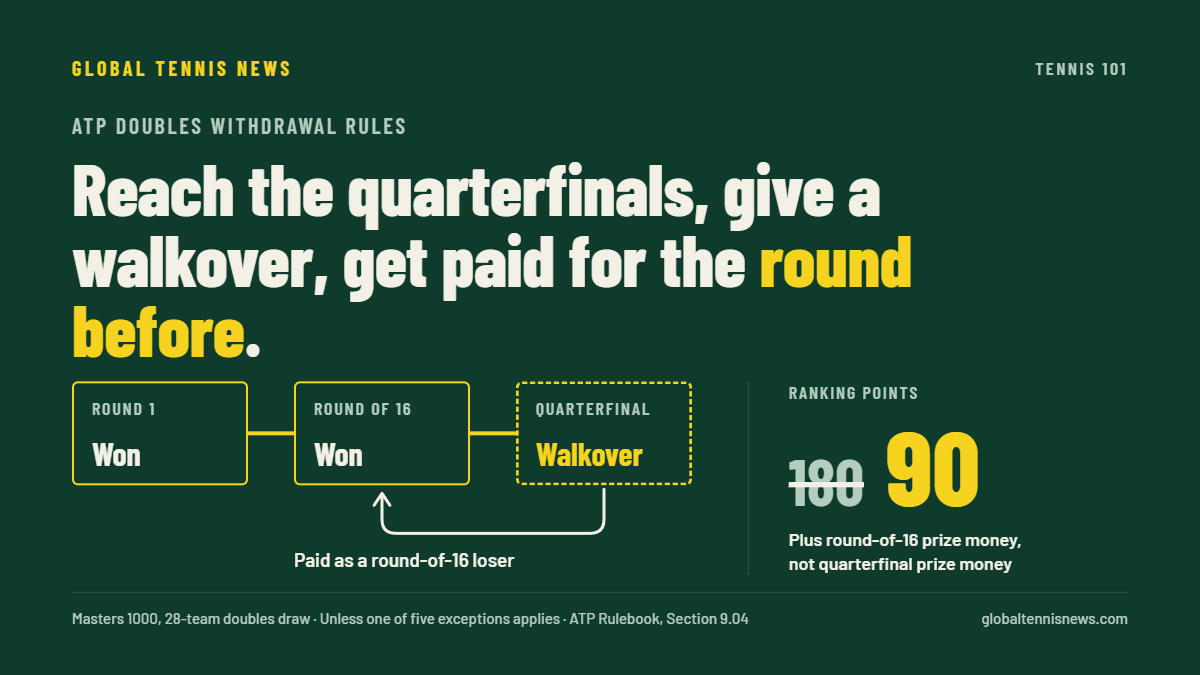
The rule. Section 9.04 of the ATP Official Rulebook, under the heading “Doubles – After First Round”, says: “Should a doubles match in an ATP Tour or ATP Challenger Tour event be uncontested or fail to be completed, the losing team shall only receive points and prize money from the previous round unless one of the following exceptions is applicable.” Uncontested means a walkover. Failing to be completed means a retirement during the match. Both are treated the same way.
What it costs. Take a Masters 1000 with a 28-team doubles draw, like Paris. A team that loses in the quarterfinals receives 180 ranking points and a team that loses in the round of 16 receives 90. If a team reaches the quarterfinals and then gives a walkover, it is paid as a round-of-16 loser: 90 points, plus round-of-16 prize money. The ranking table is explained in our guide to ATP rankings, and how doubles points feed the separate team table is in our guide to ATP doubles team rankings.
The five exceptions. The penalty does not apply, and the team keeps the points and prize money for the round reached, if any one of these holds:
- Neither player was in the singles main draw.
- Both players used, or could have used, their doubles ranking to enter the doubles draw. This does not apply to wild card teams.
- The player who retired or withdrew is still in the singles and is declared unfit by the medical examination to play the singles of that event. If he is already out of the singles, the exception applies if he is forced to withdraw from the singles or doubles of the next tournament he is entered in.
- The player who retired or withdrew was not in the singles draw and is forced to withdraw from his next event. At an ATP Tour event that means the next event he is entered in. At a Challenger it means the following week’s event, singles or doubles.
- The player had withdrawn or retired from a singles match scheduled the same day, or, if the doubles is scheduled for a later day, he is examined by the tournament doctor and declared unfit for the doubles.
The rulebook illustrates the second exception with a team in which one player has a doubles ranking of 20 and is not in the singles, and his partner is in the singles with a singles ranking of 15 and a doubles ranking of 30. If the cutoff for entry was 60, the partner’s doubles ranking alone would have got the team in, so the exception applies.
How the cases are decided. The rulebook sets out three cases. A player who retires from doubles for a medical reason, then withdraws from his next singles match with a tournament doctor’s note for the same condition, keeps the round-reached points and prize money for his team. A player who retires from singles and is confirmed by the tournament doctor as unable to play doubles that week may withdraw from the doubles at once and keep the round reached.
A player who withdraws from singles with food poisoning and pulls out of the next day’s doubles without the doctor declaring him unfit leaves his team with the previous round. The doctor’s finding is what separates the outcomes, and the rulebook adds a note that where a condition is likely to improve quickly, the doctor should examine the player on the day of the match. Treatment during matches is covered separately in our medical timeouts explainer.
Once a year, a withdrawal that does not count. A doubles ranking is built from a player’s best 18 results. Once a player is in the main draw of a Grand Slam or one of the eight Masters 1000 events, as a direct acceptance, qualifier, alternate, lucky loser or wild card, that result counts for his ranking whether he plays or not. There is one exception.
Once per player per calendar year, a team forced to withdraw after the draw is made but before its first match does not have the event counted as a tournament played. What qualifiers, alternates and lucky losers are is explained in our guide to how to read a tennis draw.
Doubles after a singles withdrawal. A player who withdraws after the deadline from the singles of a tournament may not play anywhere else that week. If the withdrawal was for medical reasons, he may still play the doubles of the same tournament, provided the Supervisor, on written medical advice, judges him physically capable of competing. The singles side of the withdrawal rules, including the Friday deadline and the fines, is covered in our ATP withdrawal rules explainer. The WTA handles late on-site singles withdrawals under its own system, explained in our guide to WTA prize money withdrawals.
When the tournament itself is not finished. A separate line in section 9.04 covers events that cannot be completed, for example because of weather. In that case loser points are awarded for the rounds the teams reached. That is different from a team’s own walkover or retirement, which is what the previous-round rule addresses.
At the ATP Finals. The season-ending doubles at the ATP Finals in Turin is a round robin, and there a retirement is handled differently. For the group standings, a retirement counts as a straight-set win or loss, and the games in that match are left out of the games-won percentage. The full order of tiebreakers is in our ATP Finals round-robin tiebreakers explainer, and the doubles format of two tiebreak sets and a 10-point match tiebreak is covered in our guide to how tennis doubles works.